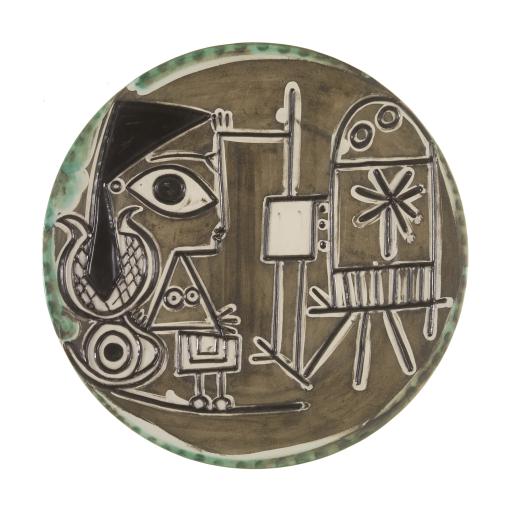
Jacqueline at the Easel, Pablo Picasso

Artwork Overview
1881–1973
Jacqueline at the Easel, 1956
Where object was made: France
Material/technique: glaze; earthenware
Dimensions:
Object Diameter (Diameter): 42.6 cm
Object Diameter (Diameter): 16 3/4 in
Credit line: Gift of Julia and Dean Mayberry
Accession number: 1991.0085
On display: Lee Study Center

If you wish to reproduce this image, please submit an image request

Images

Label texts

Form & Flux: Contemporary East Asian Ceramics and Surface Stories

In 1956, Pablo Picasso created this ceramic plate, Jacqueline at the Easel, at the Madoura Pottery workshop in Vallauris, France. This piece features his second wife and muse, Jacqueline Roque, depicted at an easel—a reversal of traditional roles that emphasizes her significance in his life and work. The design showcases Picasso's signature Cubist style, with abstracted forms and fragmented perspectives, highlighting his innovative approach to ceramics and his deep connection with Jacqueline as both partner and artistic inspiration.

Archive Label 1999:
Denying the traditional relegation of ceramics to the lesser status of craft, Picasso approached the making of ceramics with considerable energy. Working at the Madoura ceramics workshop starting in about 1946, he used the medium as a way to merge sculpture and painting, a goal that he had long been seeking in his work. Pieces such as this one were produced by taking an incised image that Picasso made in a matrix of hardened plaster, and then transferring it onto a plaque of clay, or lastre, by pressing it.

Exhibitions