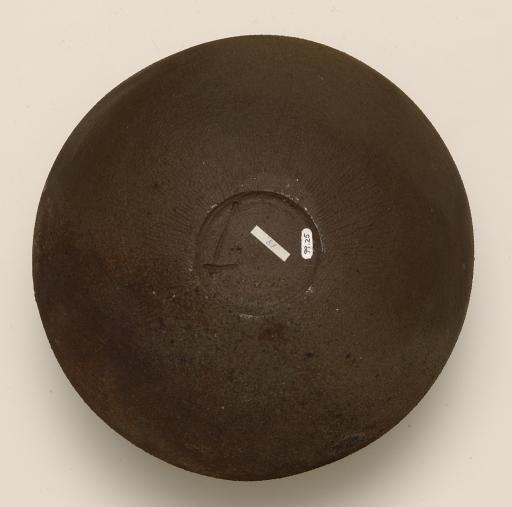
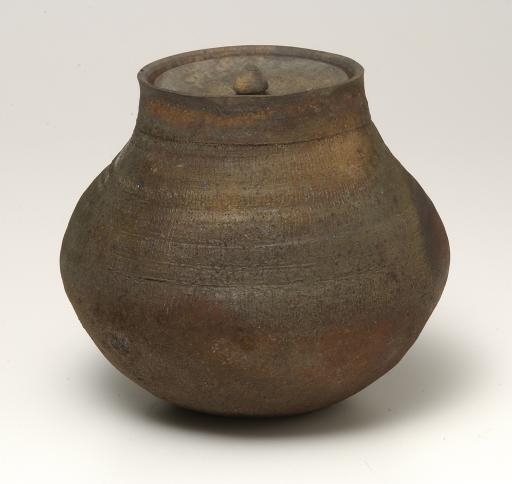
Namban mizusashi (Namban water jar with lid), Kabasawa Kenji

Artwork Overview
born 1948
Namban mizusashi (Namban water jar with lid), 1989
Where object was made: Japan
Material/technique: stoneware
Dimensions:
Object Height/Diameter (Height x Diameter): 18 x 19 cm
Object Height/Diameter (Height x Diameter): 7 1/16 x 7 1/2 in
Credit line: Museum purchase: R. Charles and Mary Margaret Clevenger Fund
Accession number: 1999.0025.a,b
On display: Lee Study Center

If you wish to reproduce this image, please submit an image request
Images

Label texts

Form & Flux: Contemporary East Asian Ceramics and Surface Stories

This simple yet sturdy mizusashi (water jar) reflects Kawasawa Kenji’s commitment to the tea ceremony. He uses a traditional wood-fired climbing kiln (noborigama), designed with multiple chambers built on a hillside to channel heat. In 1986, he constructed a more primitive snake kiln (jagama), named for its serpentine shape. Kawasawa’s most striking works, like this Namban Water Jar, are unglazed, high-temperature fired pieces, showcasing a raw, elemental beauty shaped by the kiln’s intense heat.

Exhibition Label:
"Contemporary Ceramics East and West," Feb-2002, Susan Earle, Mary M. Dusenbury
This simple and stalwart mizusashi or water jar, like much of Kawasawa’s work, was produced for the tea ceremony. Kawasawa uses a traditional wood-fired climbing kiln (noborigama), a kiln designed with a series of interior chambers and built on a hill so that heat from the fire rises through the kiln. The fire is stoked first from the front and then from side openings in each chamber. In 1986 he built a more primitive type of climbing kiln, a jigama or hebigama (snake kiln), so named because it looks like a snake crawling up the hillside on which it is built. His most striking work, like this Namban Water Jar, consists of sober, unglazed objects, fired to a high temperature in one of his wood-fired climbing kilns.

Exhibitions