Tule Lake Memory-Scape
The incarceration of people of Japanese descent is a recurring theme in Jimmy Tsutomu Mirikitani’s work. Following the attack on Pearl Harbor in December 1941, President Franklin D. Roosevelt (1882–1945) signed Executive Order 9066, authorizing the forced removal of those deemed national security threats from the West Coast to “relocation centers.” This order led to the incarceration of about 120,000 people of Japanese descent in ten camps administered by the War Relocation Authority.
Mirikitani endured one of the harsher trajectories of incarceration. In May 1942, he was sent to the Tule Lake Relocation Center in Northern California. In 1943, he answered “no” to question 27 on a controversial “loyalty questionnaire,” which asked about willingness to serve in combat in the U.S. Armed Forces. Following Tule Lake’s redesignation as a segregation center in 1943, under pressure and without legal counsel, Mirikitani—along with about 5,500 others—was coerced into renouncing his U.S. citizenship. After the camp closed in 1946, he was transferred to Crystal City, Texas, and later to Seabrook Farms, New Jersey, where he labored until 1947 under “relaxed internment.”
Many of Mirikitani’s works repeat a similar composition: long rows of Tule Lake barracks with Castle Rock and Mount Shasta in the distance. These works underscore the incarceration’s enduring impact on his life. At the same time, subtle variations in motif, text, and material evoke shifting perspectives on Tule Lake and the layered, evolving nature of memory.

Jimmy Tsutomu Mirikitani, untitled (Tule Lake: artist, rabbit, woman and child), circa 2001, Collection of Linda Hattendorf, Taos, New Mexico, EL2024.155
Video Introduction
This video consists of footage edited by Linda Hattendorf that was not included in her documentary The Cats of Mirikitani (2006) and reveals moments central to Jimmy Tsutomu Mirikitani’s life and work. Returning to the site of his wartime incarceration, Mirikitani sketches the land, gathers flowers, exhibits his art, and reflects on memory and loss.
untitled (Tule Lake: artist, rabbit, woman and child)
untitled (Tule Lake: artist, rabbit, woman and child), Jimmy Tsutomu Mirikitani

untitled (Tule Lake: artist, rabbit, woman and child) label
This work can be considered the quintessential image of Tule Lake that Mirikitani created before 2002. Castle Rock and a red sun occupy the upper section, in front of which extends a long row of barracks separated by a wired gate and fence. Far in the distance behind Castle Rock rises Mount Shasta, whose conical form is often compared to that of Mount Fuji. Although the tone and atmosphere differ entirely, the composition clearly recalls his earlier Nihonga-style painting of Tule Lake from the 1940s.
In the foreground appear a rabbit, sagebrush, and two small anonymous figures, along with a self-portrait of Mirikitani in a red beret sketching. Sharp hatching lines made with a ballpoint pen, vivid red accents, and the steep perspective used to depict the series of barracks leading toward Castle Rock together create a bleak yet strikingly intense image of the incarceration site. By incorporating his own figure—alongside inscriptions that note his study with Nihonga masters in Tokyo and identify him as “a Hiroshima native”—Mirikitani underscores both the authenticity of his memory and the artistic skill with which he captured the scene.
Explore more
untitled (Tule Lake: “End of War and Return”)
untitled (Tule Lake: “End of War and Return”), Jimmy Tsutomu Mirikitani

untitled (Tule Lake: “End of War and Return”) label
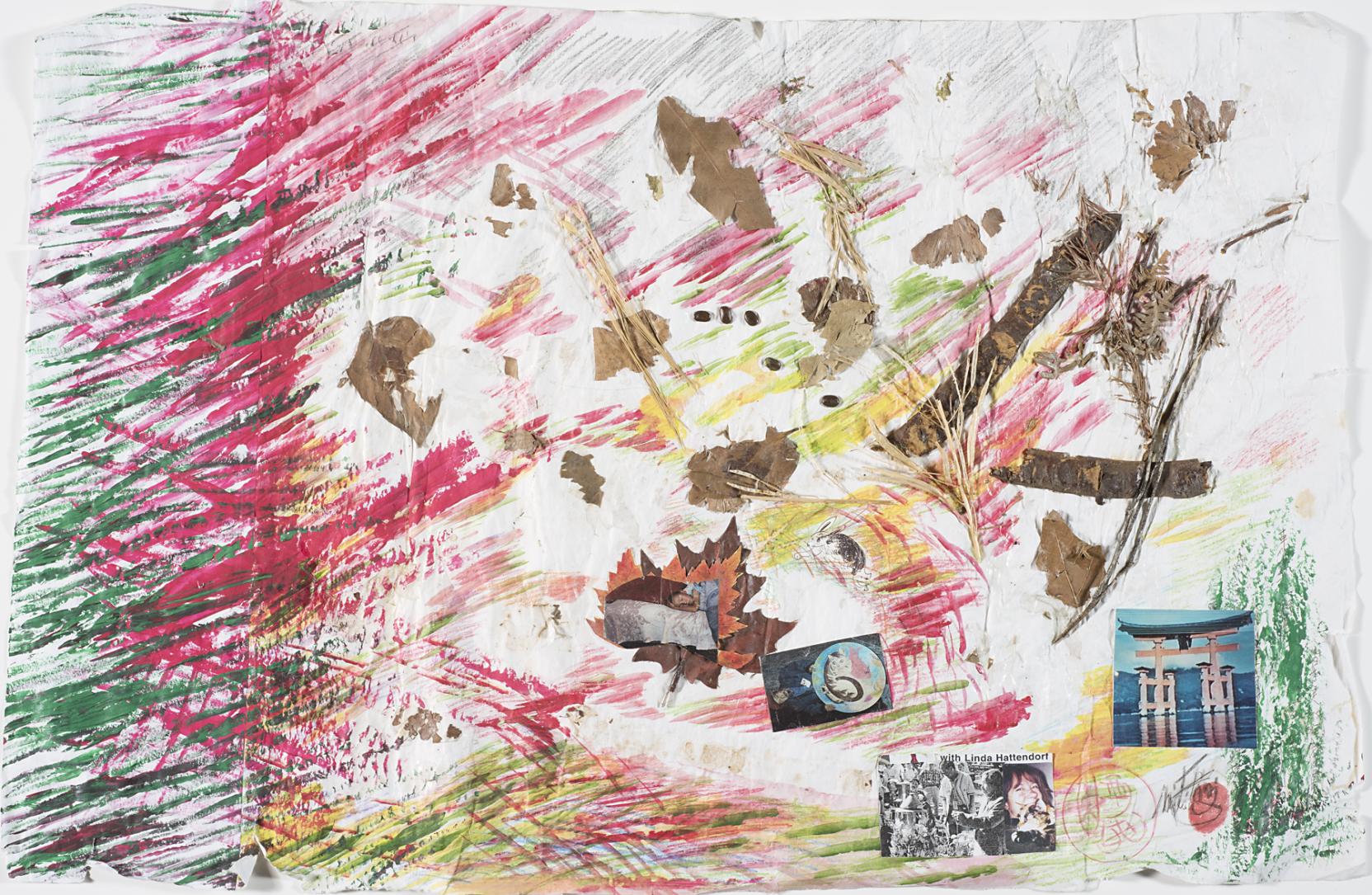
In 2002, Mirikitani participated in the Tule Lake Pilgrimage—presumably his first visit to the site in 50 years. After the trip, he produced a significant number of works, as if to capture this pivotal moment in his life. While many retain compositions and motifs from before 2002, subtle differences emerge. The camp gate is now often shown open or broken, and collage elements become increasingly complex, as seen in this work.
Centered on Castle Rock, this work combines drawing and collage with dense layers of inscription. The upper right includes images of Fudō Myōō (Acalanātha), shrine objects, and a Japanese sword. The upper left features Admiral Yamamoto Isoroku (1884–1943) with a caption about Pearl Harbor, partly overlapped by an obscured battleship, possibly the USS Arizona. A Japanese inscription beside the sun motif praises “the spirit of the Kamikaze boys.” Below appears a photograph of incarcerees, a note reading “End of War and Return,” a watchtower, and a prayer for remembrance.
With imperial icons, jingoistic slogans, and prayers for justice and peace coexisting in a single frame, Mirikitani’s image of Tule Lake reveals a complex layering of memory—one that invites reflection on how intertwined histories of violence and remembrance shape the act of commemoration.
Explore more
untitled (Tule Lake: Castle Rock Mountain, barracks, cross)
untitled (Tule Lake: Castle Rock Mountain, barracks, cross), Jimmy Tsutomu Mirikitani

untitled (Tule Lake: artist, rabbit, woman and child) label
This drawing of Castle Rock—accented with colored pencil and inscribed with Mirikitani’s characteristic handwritten text—depicts the iconic lava formation overlooking the Tule Lake incarceration camp in northern California. More than 18,000 Japanese Americans were confined at Tule Lake during World War II. The cross atop the ridge marks a memorial erected by Japanese American Christian incarcerees to honor those who died in confinement. Rows of barracks stretching below evoke the camp’s stark geometry.
The reverse side of the collage includes the Tule Lake dance band, which featured the Koyasako brothers in matching Hawaiian shirts. Among them, Suenari Koyasako (b. 1920) served in the camp’s post office and, along with his brothers, performed in a group known as the Paradise Melodiers, a band that “entertained the camp administrators as well as internees.” These musicians, like Mirikitani, asserted creativity and dignity within confinement—bridging divided worlds “on the other side of the fence.”
View the back of this collage

Explore more
Reflections
Read interpretive texts about some of Mirikitani’s works from the Tule Lake Memory-Scape section, written by his closest friends and documentarians, Linda Hattendorf and Masa Yoshikawa, together with curator Maki Kaneko. These texts are reprinted from the exhibition catalogue, which features many more essays and analyses for those interested in exploring Mirikitani’s work in greater depth.
untitled (Tule Lake), Jimmy Tsutomu Mirikitani

External Resources
untitled (Tule Lake collage), Jimmy Tsutomu Mirikitani
External Resources
Dive Deeper: Tule Lake Reflections
Roger Shimomura speaks about the lived experience of Japanese Americans incarcerated during World War II. Video footage from Linda Hattendorf.
Next Section
Multiple Ground Zeros
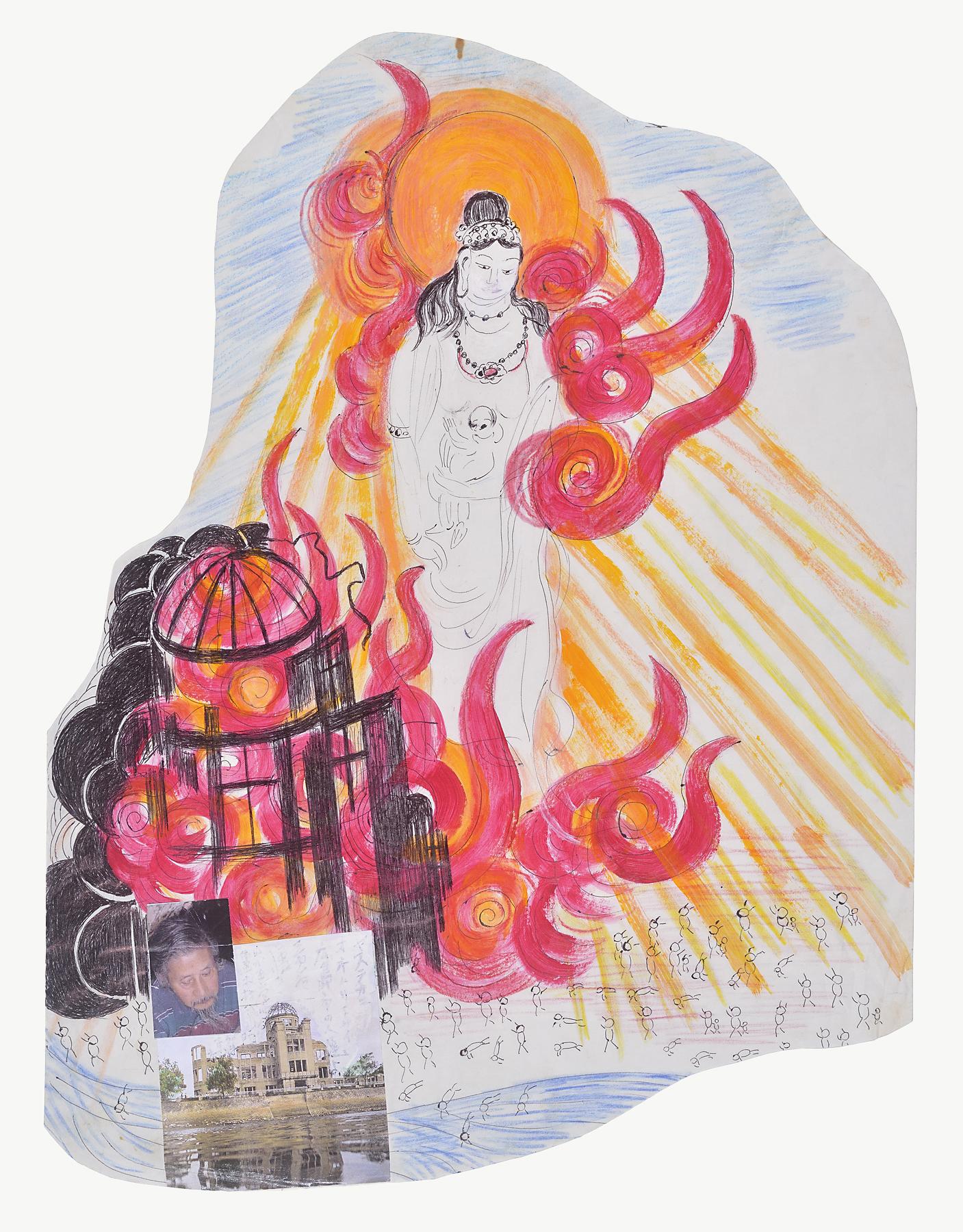
Mirikitani, who directly or indirectly experienced the atomic bombings of Hiroshima and the terrorist attack in New York on September 11, 2001, turned these “Ground Zeros” into central motifs in his art. While they call for remembrance, these works also hold devastation and renewal, horror and beauty, military imagery and prayers for peace in uneasy coexistence.