Beadwork and Horror
Applying her photorealistic style to a classic 1980s horror character, Jamie Okuma (Luiseño, Shoshone-Bannock, Wailaki, Okinawan, La Jolla band of Indians in Southern California) pushes the boundaries of contemporary Native beadwork with Becoming (2022). Okuma is a nationally renowned artist and fashion designer best known for beading on high-fashion brands such as Louboutin. She is also an avid horror fan, which is why Becoming features the startling image of Pinhead, a popular character from the Hellraiser franchise. The backpack is part of a horror series by Okuma, which includes beaded works featuring Hannibal Lecter from Silence of the Lambs, Lucy Westenra from Dracula, and Pennywise from IT.
“The stories that I remember growing up were the ‘horror’ Native stories my grandmother would tell my cousins and I. They were awful and brutal but they were to teach. Be careful, pay attention to those around you, to your surroundings…” Okuma shared on social media.
To create Becoming, Okuma picked up approximately 50,000 beads with a needle, one by one, guiding each onto thread and sewing it to the leather bag. This process took over three months, and each square inch of the work holds approximately 400 beads. While there are some beadwork stitches that allow you to place multiple beads at once, Pinhead’s face is entirely single-stitched, which means that each bead is individually placed.
Beading is a significant act of resistance for many Indigenous people in the United States and Canada because of the long history of discrimination against Native artists and the appropriation of Native designs. Colonizers attempted to forcibly assimilate Indigenous people by creating policies that heavily restricted cultural and artistic expression. In this context, contemporary beading is a way for Native artists to claim agency and control of crafting practices and designs.
The concept of (re)beading, introduced by Scholar Emily C. Van Alst, denotes the practice of revitalizing beadwork techniques in the face of erasure and reclaiming Native space through beaded artwork. When Native artists bead, they claim both the physical space of their work and the right to be seen. Van Alst argues that the act of beading on high fashion items and beading images of pop culture characters are important methods of establishing Indigenous peoples’ rights to self-representation in contemporary art and society. In a society that often erases signs of contemporary Native life, reimagining pop culture and horror characters in one’s own image can be an empowering opportunity.

Jamie Okuma, Becoming, 2022
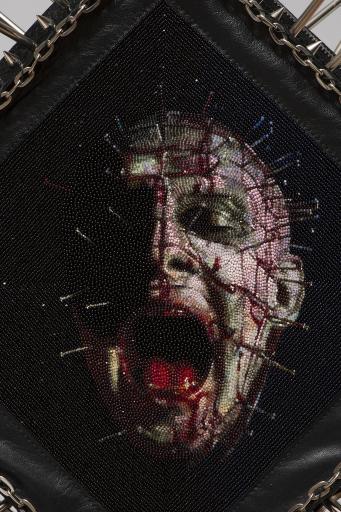
Both beadwork and horror films can help people grapple with difficult subjects. Some bead workers use the time-consuming practice of beading to process emotions. The very process of beading can represent a refusal to “solve” and move on from negative emotions. The emotional potential contained in horror-inspired beadwork also relates to how horror is perceived by different audiences. Some marginalized communities have turned to horror as a way to celebrate their differences rather than conform. In many horror stories, the monster is styled as the “other,” someone or something who defies the norm and is ostracized for it. The monsters in Hellraiser are specifically a queered other, inspired by director Clive Barker’s experience of the 1980s BDSM scene. By claiming solidarity with the monsters, people reject the shame that comes from failing to meet impossible standards. Like the process of beadwork, the genre of horror can be a mechanism for processing social anxieties by facing them, rather than ignoring them.
Although Pinhead’s image may be unexpected on a beaded backpack, the idea of combining a delicate and beautiful craft with a bloody image is true to the original intent of Hellraiser. As Barker shared in an interview for the book British Horror Cinema (2002), “Hellraiser tried to achieve images with a visual undertow where things could be beautiful and repulsive simultaneously; images that could fascinate and disgust in equal measure.”
By holding horror and beauty together, Barker’s Pinhead resists the binary of good versus evil in favor of a character with more complicated motivations and intentions. With Becoming, Okuma similarly refutes a simple narrative of what “good” Native art looks like, utilizing her undeniably expert beading to capture the gruesome image of blood spilling down Pinhead’s mutilated face.
Becoming is ultimately a work about choices and transformation. The monsters in Hellraiser, called cenobites, are summoned whenever a human solves a mysterious puzzle box, which Okuma meticulously sewed on the back of Becoming. Pinhead was human until he solved the puzzle box and transformed into a cenobite, who then offers the same choice to others. Okuma explores the character’s transformation from human to cenobite as a way to think about choices and consequences. “It’s all about your perspective and how you choose to become,” she wrote on social media when she revealed Becoming. “Here you have a man that chose his path. In the moment it was panic and regret for him. In the aftermath the viewer is meant to see him as a villain. Is he though? He only arrives when called upon, someone’s choice to summon him. Wanting something other.”
When viewed through the lens of Becoming, Pinhead represents the bold potential to make choices that appear wrong and unnatural to a normative society. Through her horror-inspired beadwork, Jamie Okuma refuses assimilation and erasure in favor of exploring a bold, unsettling, and unrepentant Indigeneity.

Jamie Okuma, Becoming, 2022

View another story
Artist-in-Residence Spotlight Mary Sibande