Christmas at Hinky Dinky, Lincoln, Nebraska, James Alinder
Artwork Overview
Image Dimensions Height/Width (Height x Width): 19.2 x 42.4 cm
Image Dimensions Height/Width (Height x Width): 7 9/16 x 16 11/16 in
Mat Dimensions (Height x Width): 20 x 25 in
If you wish to reproduce this image, please submit an image request
Images
Label texts
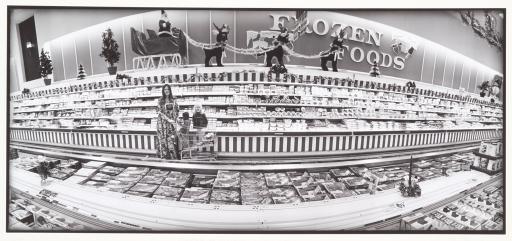
Christmas at a Hinky Dinky? This photograph by James Alinder presents the vastness of a grocery-store frozen food section, with a cheery family group and their shopping cart wedged like a cardboard pop-up, in among the many rows of packaged items. The scene seems almost fanciful, unbelievable, not only due to the vast quantity of frozen things, but also because of the distortion produced by the 150-degree-angle panoramic that the photographer created with his lens.
The family we see amidst the rows of food, with nothing fresh in sight, reminds us of the many ways that products of automation and industrialization now dominate our once nature-centered planet. Similarly, above the shelving, a trio of seemingly hand-made holiday reindeer echo this reminder, as do the overshadowed humans, stuck as they all are in this carefully arranged shopping space.
In 1971, when this photo was taken, the huge frozen food sections of supermarket chains like Hinky Dinky offered an astonishing boon to busy families, allowing them to pull dinner from the freezer and onto the table in a fraction of the time that it would take to prepare and cook a similar meal.
Stores like Hinky Dinky and Piggly Wiggly permanently altered the ways that people in the U.S. purchased food for their families. Alinder shows us how dominant, and exciting, all the recently innovated frozen-food options were at the time, enjoyed by the family in the photograph along with millions of others.
Founded in 1925 in Nebraska, Hinky Dinky featured fifty stores at its peak. Now there are none. As of 2025, dozens of supermarket chains, including Hinky Dinky, and the A&P that I grew up with in the New York area, have gone out of business, due to changes in habits and the tough competition of the grocery-store field. Other stores (and desires?) have replaced them.
Susan Earle gives the now-defunct Hinky Dinky supermarket chain three and a half stars.
James Alinder photographed his family in a frozen food aisle with Christmas decorations in Hinky Dinky, a supermarket chain based in Nebraska that no longer exists. A young child of color sits in the shopping cart surrounded by his white mother and sister. The boy might have been adopted, although the artist did not confirm this. Since the 1950s, supermarkets with fully stocked racks, clean aisles, and beautifully presented goods at affordable prices have been symbols of the economic wealth and stability of the United States, as well as a culture of consumption. Within this exhibition, Alinder’s photograph offers a critical perspective to contemplate potential commodification of adoptions.
James Alinder photographed his family in a frozen food aisle with Christmas decorations in Hinky Dinky, a supermarket chain based in Nebraska that no longer exists. A young child of color sits in the shopping cart surrounded by his white mother and sister. The boy might have been adopted, although the artist did not confirm this. Since the 1950s, supermarkets with fully stocked racks, clean aisles, and beautifully presented goods at affordable prices have been symbols of the economic wealth and stability of the United States, as well as a culture of consumption. Within this exhibition, Alinder’s photograph offers a critical perspective to contemplate potential commodification of adoptions.
Exhibition Label:
"Conversation VIII: Serious Play," Jun-2010, Kate Meyer and Susan Earle
When we play we have fun. The works on view in this installation have been selected to respond to the video by Pipilotti Rist, I Want to See How You See. Many of these objects draw upon memories of childhood or references to childhood and the body to produce biographic narratives. In many instances, these memories are subversions of the ideal innocence of youth portrayed by fiction. Childhood can be a time of anxiety or repression that informs our experiences as adults. Another theme suggested by the video relates to multiple and distorted perspectives of vision. For his photographs, James Alinder employs a fisheye lens to deliver surrealistic perspectives. For his triptych, Robert Rauschenberg incorporates a distortion-lens camera to produce the central panel, which includes an oval-shaped text that lists the key events and influences in the artist’s life. In Rist’s video, these explorations of perspective appear to link the idea of vision (seeing) with perception (understanding).
Exhibition Label:
"Signs of Faith: Photographs from the Collection," Oct-2001, Elissa L. Anderson
Alinder emphasizes the commercialization of religion in this photograph of a Nebraskan supermarket’s frozen-foods section. The suburban family, mesmerized by the seemingly endless rows of microwave dinners and cartons of ice cream, ignores the handmade Christmas decorations arranged overhead.
Exhibition Label:
"The Family in Photography," Dec-1997, Stefanie Vigil
Only in recent times has the everyday routine of the family become the subject for family photographs. Rather than show the festivities of the family Christmas celebration, Jim Alinder shows his family shopping for their holiday meal.
Exhibitions


Wyatt Haywood, curator
Suzanne Huffman, curator
Ellen Joo, curator
Luke Jordan, curator
Arial Kim, curator
Doug Bergstrom, curator
Susan Earle, curator
Sofía Galarza Liu, curator
Kevin Liu, curator
Kate Meyer, curator
Cara Nordengren, curator
Hana Rose North, curator
Liz Pfeiffer, curator
Sydney Pursel, curator
Rachel Straughn-Navarro, curator
Eli Troen, curator
Maggie Vaughn, curator