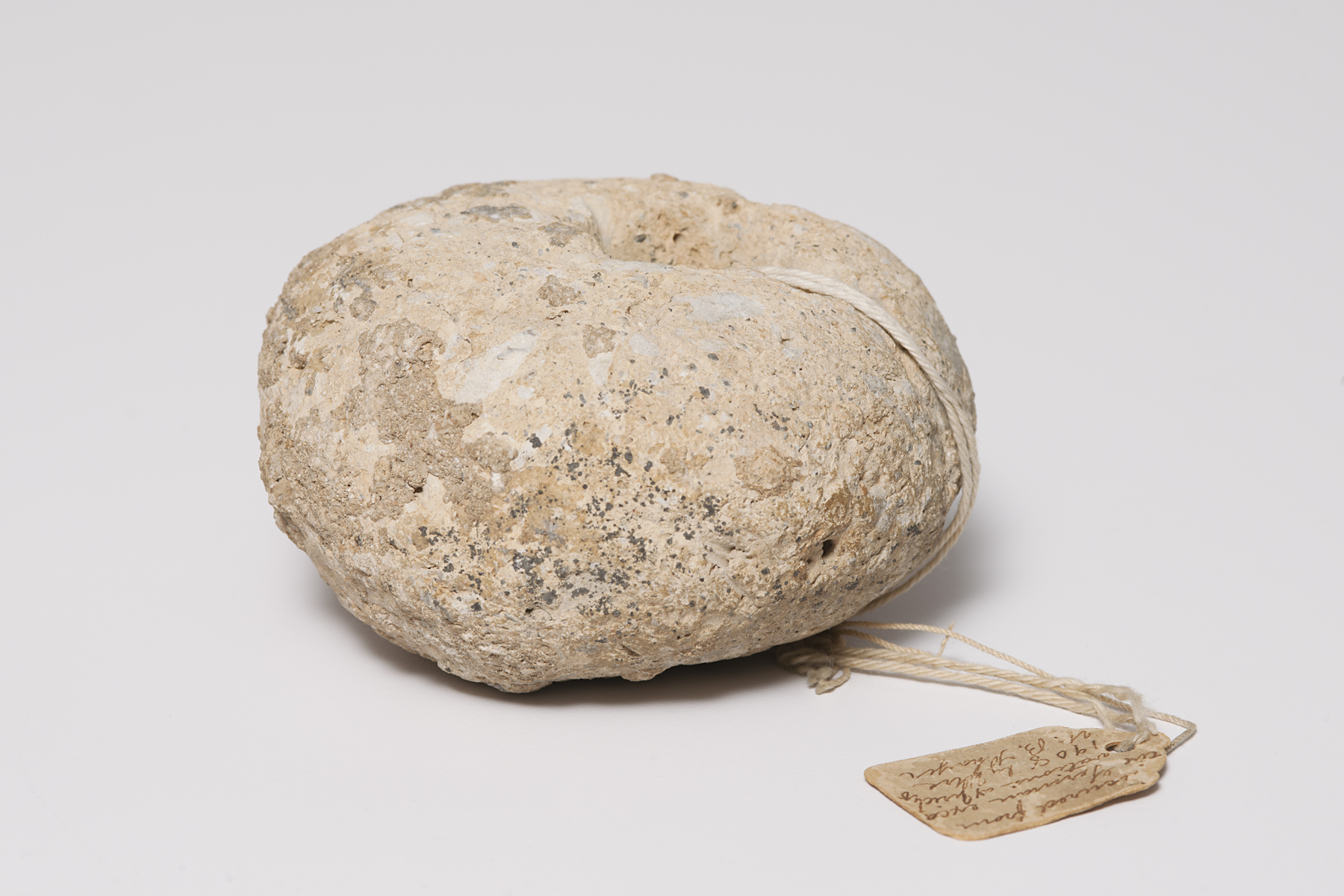
loom weight, unknown maker from Jericho
Artwork Overview
If you wish to reproduce this image, please submit an image request
Images
Label texts
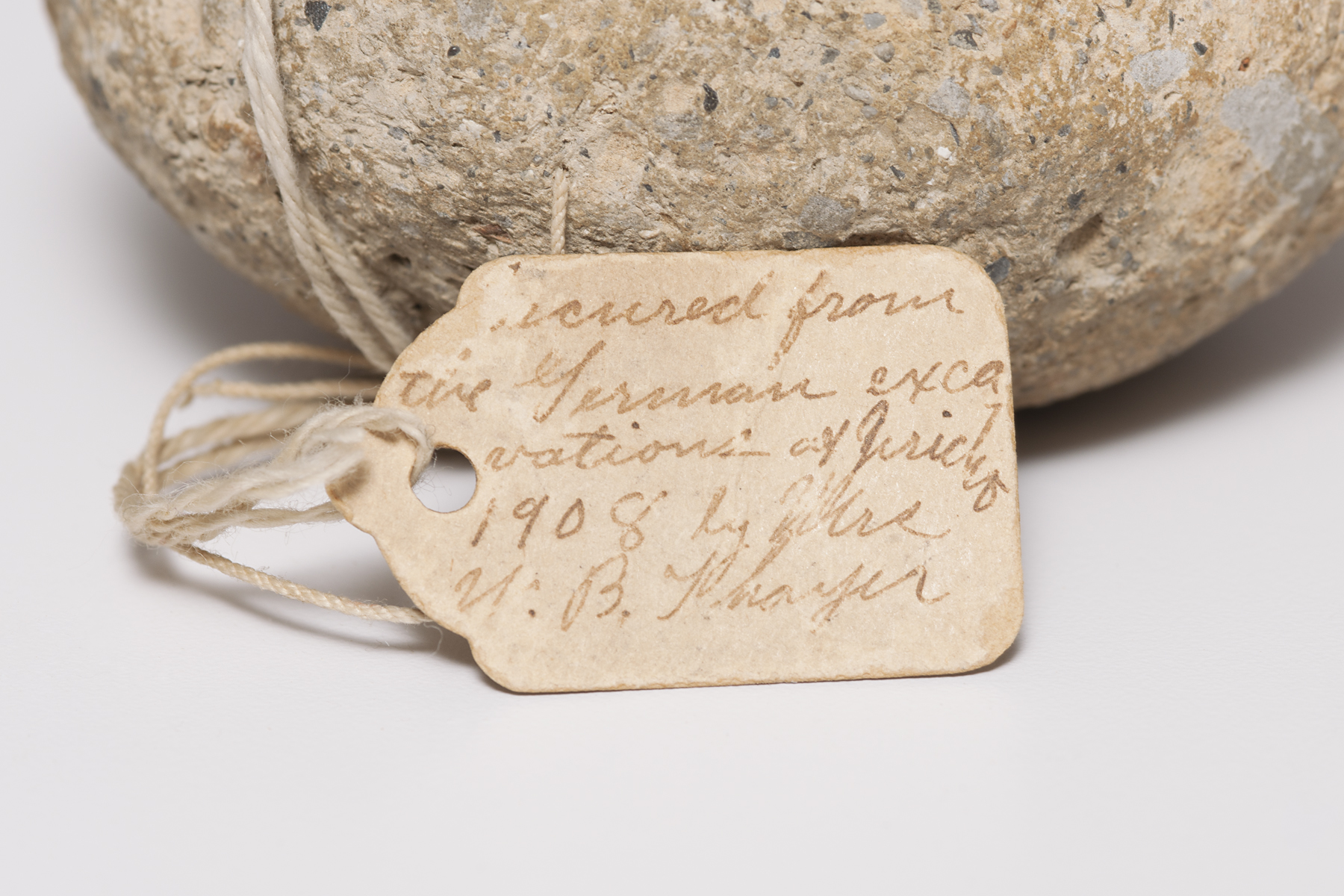
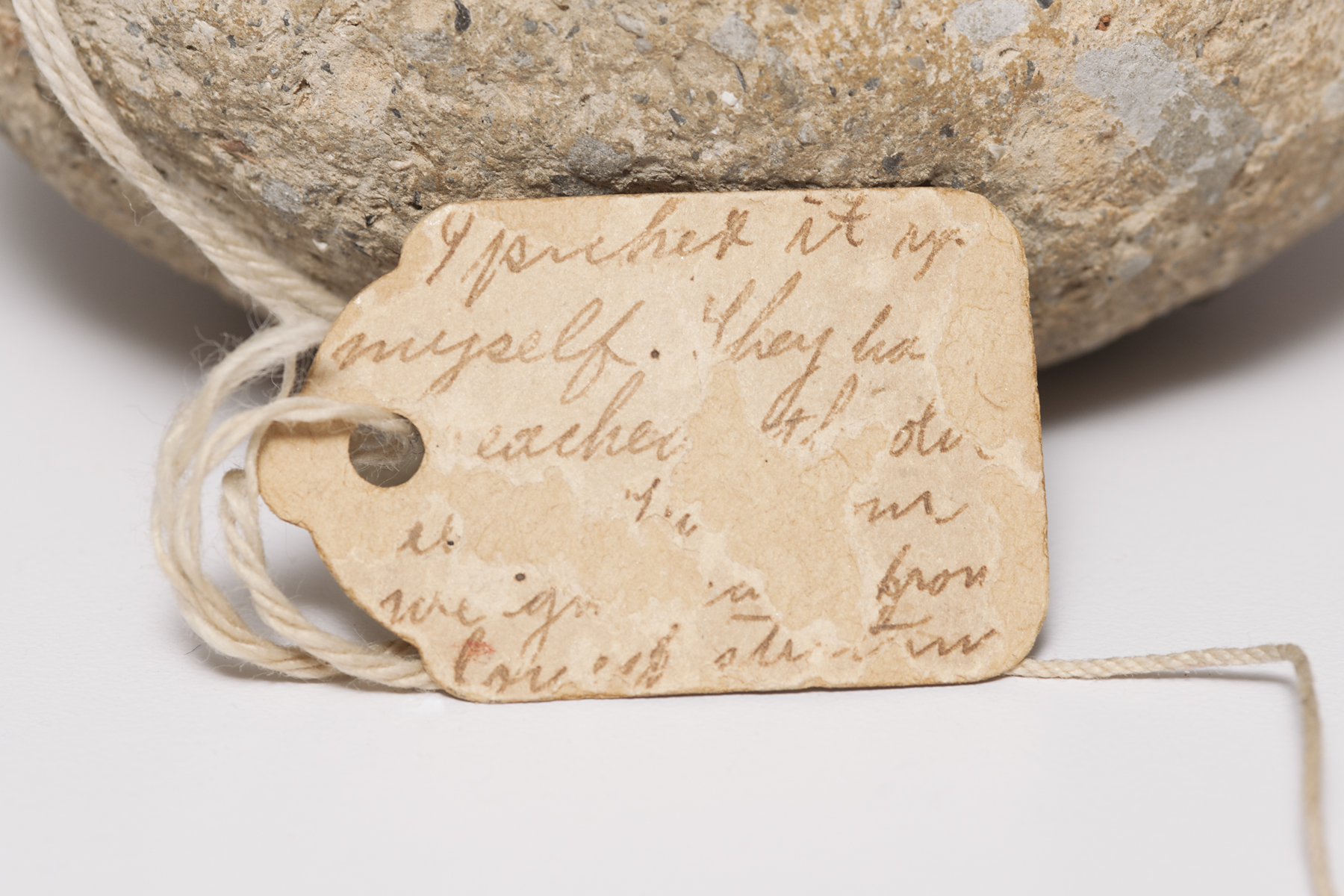
Tied around this dull, donut-shaped rock is a string with a small tag that has a partially readable inscription by Sallie Casey Thayer: “[Se]cured from the German excavations at Jericho 1908 by Mrs. W. B. Thayer. / I picked it up myself. They had [r]eached [the lowest walls. This loom] weight [came] from [the] lowest str[a]tum.”
Shortly following her husband’s death in 1907, Thayer marked a new phase of her life as a collector, traveling with her son on an overseas trip in early 1908. They went to Europe, particularly along the Mediterranean coast, as well as Gibraltar, Tangier, and Palestine. It is likely that Thayer literally “picked up” this loom weight when they visited the Austro-German excavation of Jericho led by Ernst Sellin and Carl Watzinger.
Have you ever picked up anything important to the past, whether historical and/or personal? Does it remind you of a trip or other experiences? Have you somehow identified it for others to understand?
What kinds of objects are important to you and what do you do with them? Could they also be important to others?
Who else might this loom weight be important to and why?
Humans have moved geographically far longer than we have stayed in one location. We hunted and gathered food for millennium before we learned how to domesticate plants, build shelters, and form communities. However, once we did settle down, the yearning to keep moving didn’t go away and we began to travel. Sometime in the latter half of the last millennium, as our world became smaller due to advances in technology, folks began travelling not for work, war, religion, nor trading, but purely for pleasure—creating the modern idea of tourism.
When Sally Casey Thayer and her husband went on their travels around the world, they frequently brought home with them a souvenir—something by which to remember their travels. In this instance, while visiting Jericho in 1908, Sally picked up this small rock with a hole in it. Later, she attached the label seen here today to remind herself and inform us that this was a loom weight from the lowest layer of excavations from one of the oldest known cities. Sally’s souvenirs form a large portion of the approximately 7,500 objects she gave to the university in 1917 that serve as the basis for the collection of artwork that the Spencer holds today.
Tourism and souvenirs are a double-edged sword—they create new experiences, boost economies, and make our world much more interconnected, but in doing so can harm our environment and culture. Many places are dealing with overtourism and the souvenir market creates a large amount of trash using unsustainable labor. Souvenirs are rarely works by local artists but are much more likely to be mass-produced items such as keychains or magnets. My parents buy me a shot glass from every place they visit, which goes unused and unseen in a back cabinet.
Despite this, I’m still drawn to souvenirs to form a physical collection of my memories and life. Like Sally Casey Thayer, I too picked up a rock from a discard pile while visiting an archaeological site that sits on a shelf at home. This little pot sherd, a fragment of a handle of a Greco-Roman vase, from an archaeological excavation at Agrigento on Sicily serves as a fond memory of a difficult, but exceedingly meaningful study abroad.
Wyatt Haywood gives souvenirs three and a half stars.
This ancient artifact was taken from an archaeological dig in Jericho (present-day West Bank, Israeli-occupied territory) by Spencer benefactor Sallie Casey Thayer. On the attached tag, she wrote, “Secured from the German excavations at Jericho 1908 by Mrs. W.B. Thayer. I picked it up myself. They had reached the lowest walls. This loom weight came from the lowest stratum.” Removing this artifact from its original context created issues in establishing a social history for the object, but there are still many clues we can gather to create an impression of the Canaanite woman who used this tool to weave textiles more than 3,600 years ago. Archaeological evidence from similar sites suggests that looms were set up in kitchens or on the second floor of houses, away from the main entrance. The woman who used this object was an expert weaver who could determine how many threads she needed to support the weight just by feeling its heft in her hand. This heavy weight worked best with a heavy yarn to weave a coarse, thick cloth. She carefully threaded her linen or wool warps over the frame of her loom and through this weight, which held the threads taut as she wove other threads through them to make textiles. She made cloth to dress her family and also for trading to help provide for her family and community. By standing in proximity to this well-used tool in the Museum, we are also close to this woman from Jericho.
Shortly following her husband’s death in 1907, Sallie Casey Thayer marked a new phase of her life as a collector. With her son, Thayer departed for an overseas trip in early 1908. Their travels included stays in Mediterranean coastal Europe, as well as Gibraltar, Tangier, and Palestine. According to her own account, she literally “picked up” this loom weight when they visited the Austro-German excavation of Jericho.
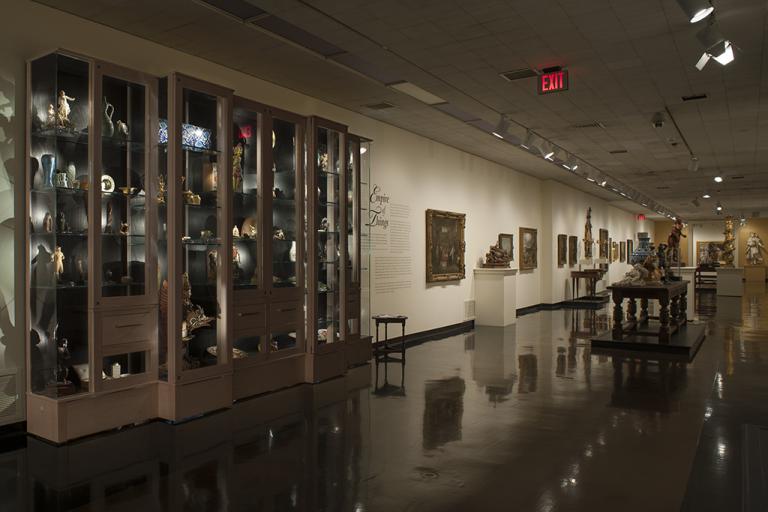
Weavers used loom weights to help keep yarn tight as they worked. Look for this loom weight in the Cabinet of Curiosities in the exhibition Empire of Things. A small tag tied around this loom weight bears a partially legible inscription written by Sallie Casey Thayer: “[Se]cured from the German excavations at Jericho 1908 by Mrs. W. B. Thayer. / I picked it up myself. They had [r]eached [the lowest walls. This loom] weight [came] from [the] lowest str[a]tum.”
Tap the image above and swipe to view the inscriptions on the front and back of the tag.
This loom weight is part of the extensive art collection donated by Sallie Casey Thayer to KU in 1917. Weavers used loom weights to help keep yarn taunt as they worked. The tag reads, “Secured from the German excavation at Jericho 1908 by Mrs. WB Thayer."
This loom weight is part of the extensive art collection donated by Sallie Casey Thayer to KU in 1917. Weavers used loom weights to help keep yarn taunt as they worked. The tag reads, “Incurred from the Herman excavations at Jericho 1908 by W. B. Thayer.”
This loom weight is part of the extensive art collection donated by Sallie Casey Thayer to KU in 1917. Weavers used loom weights to help keep yarn taunt as they worked. The tag reads, “Incurred from the Herman excavations at Jericho 1908 by W. B. Thayer.”
This loom weight is part of the extensive art collection donated by Sallie Casey Thayer to KU in 1917. Weavers used loom weights to help keep yarn taunt as they worked. The tag reads, “Incurred from the Herman excavations at Jericho 1908 by W. B. Thayer.”
Exhibitions


Wyatt Haywood, curator
Suzanne Huffman, curator
Ellen Joo, curator
Luke Jordan, curator
Arial Kim, curator
Doug Bergstrom, curator
Susan Earle, curator
Sofía Galarza Liu, curator
Kevin Liu, curator
Kate Meyer, curator
Cara Nordengren, curator
Hana Rose North, curator
Liz Pfeiffer, curator
Sydney Pursel, curator
Rachel Straughn-Navarro, curator
Eli Troen, curator
Maggie Vaughn, curator