Sidewalk Stories
Most of Jimmy Tsutomu Mirikitani’s known works were created during and after his years living on the streets of New York City, from the late 1980s to 2001, which the artist later described as his “sidewalk time.” The sidewalks and parks of Lower Manhattan became his studio, gallery, and meeting place. Through a steady practice of drawing and collage, Mirikitani sustained his daily life while sharing his largely unrecorded life stories with the public.
This section features two main groups of works from and beyond this period: his signature cat drawings and his autobiographical “life documents.” On the streets, Mirikitani used cat drawings—approachable images that caught the attention of passersby and invited conversation. Once people stopped, he often introduced more politically charged autobiographical works to convey the histories and events that shaped his life and his community.
Mirikitani’s “life documents” include collage works he called “education papers,” which record aspects of his biography, education, and artistic career. When approached by pedestrians or questioned by police, Mirikitani often presented these works as a form of identification and introduction.
Sidewalk Stories invites viewers to follow Mirikitani’s journey through the visual record he created.

Jimmy Tsutomu Mirikitani, untitled (cat with fish and peppers), date unknown, Collection of Linda Hattendorf, Taos, New Mexico, EL2024.141
Video Introduction
This video consists of footage edited by Linda Hattendorf that was not included in her documentary The Cats of Mirikitani (2006) and reveals moments central to Jimmy Tsutomu Mirikitani’s life and work. Bundled up and wearing fingerless gloves, Mirikitani draws in parks and on sidewalks, transforming everyday city corners into impromptu galleries as passersby stop, look, and linger.
untitled (cat with blue peony)
untitled (cat with blue peony), Jimmy Tsutomu Mirikitani
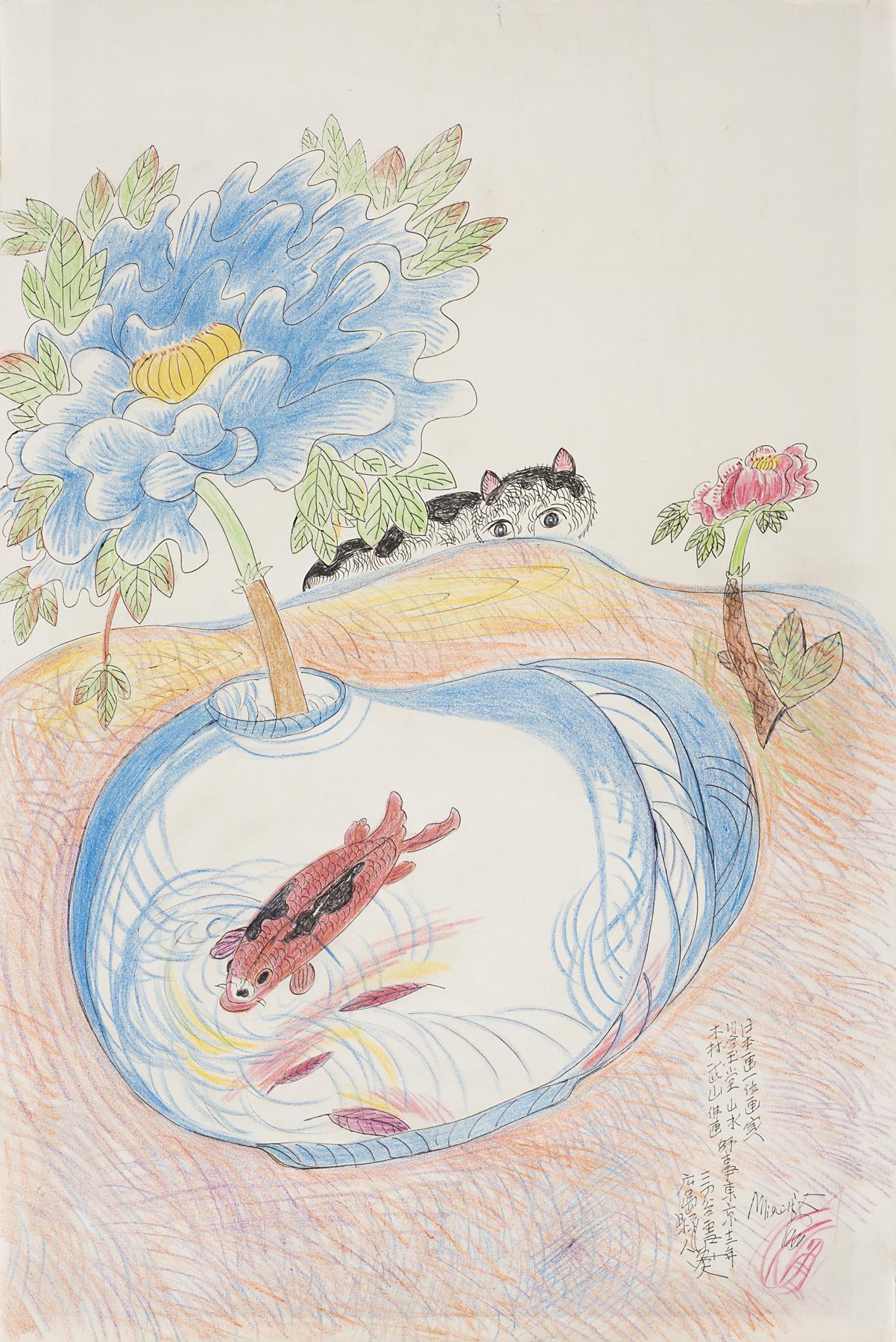
untitled (cat with blue peony) label
A cat in the background curiously gazes at koi (carp) and flowers in the foreground. Vividly drawn with ballpoint pens and colored pencils, this is a prime example of Mirikitani’s cat drawings—his signature motif. Mirikitani loved cats and created a large number of such works. While it is known that he used cats, along with other “cute” motifs such as flowers, vegetables, and animals, to attract pedestrians, what these motifs meant to the artist remains a topic of debate. They may represent an homage to a cat-loving friend who died in an incarceration camp, his admiration for the Japanese French artist Foujita Tsuguharu (Léonard Foujita) who was known for his cat paintings, or specific individuals familiar to Mirikitani himself.
His signature appears in the lower right, a hand-drawn seal of his Japanese painter’s name Setsuzan (“Snow Mountain”), and an inscription naming the acclaimed Nihonga artists Kawai Gyokudō (1873–1957) and Kimura Buzan (1876–1942) as his teachers. This combination of signature, seal, and inscription appears in nearly all of the works in this exhibition, reflecting Mirikitani’s profound pride in his artistic heritage.
Explore more
untitled (“education paper") separate entries
untitled (“education paper” with owl), Jimmy Tsutomu Mirikitani
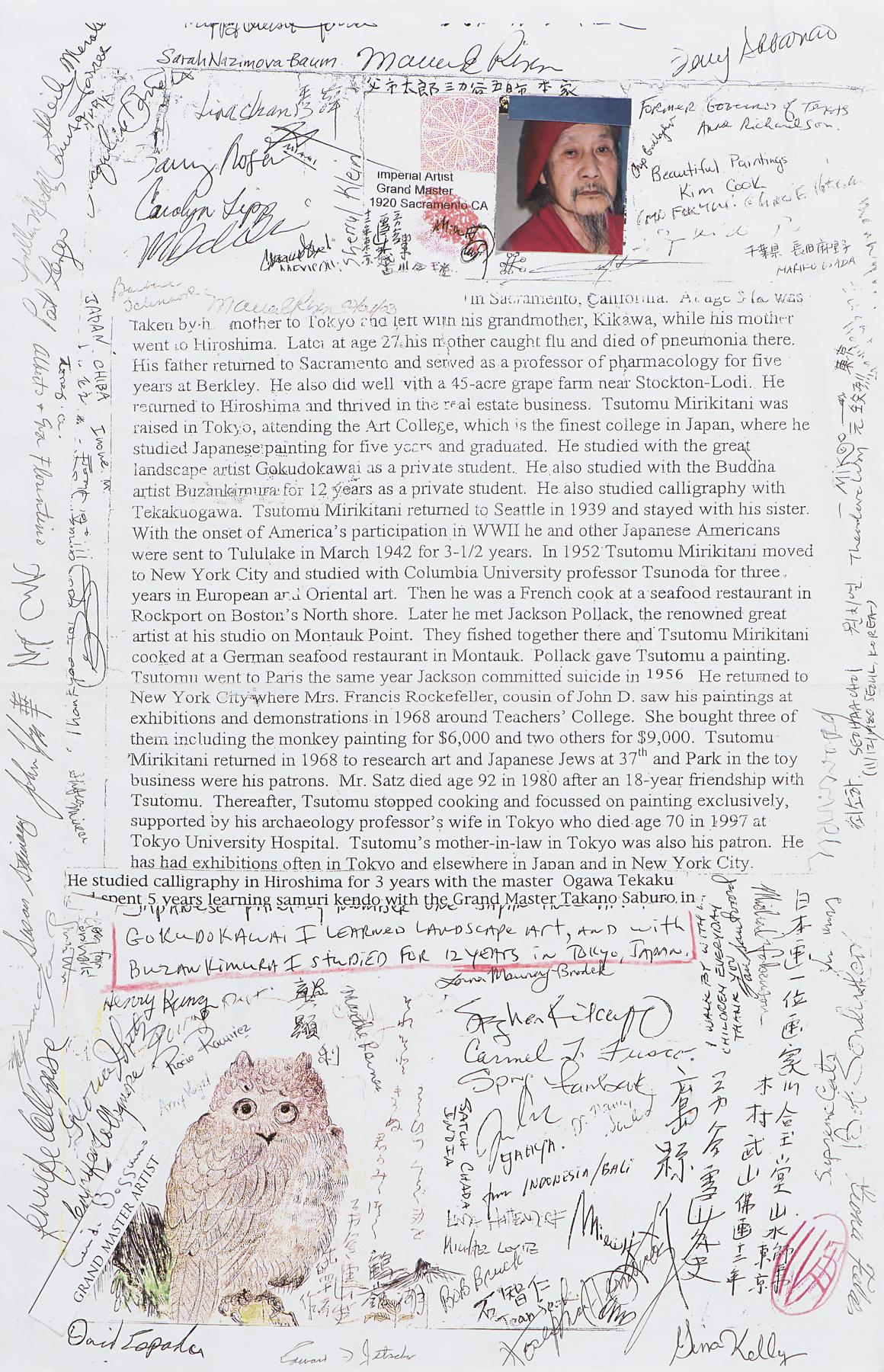
untitled (“education paper” with owl 2), Jimmy Tsutomu Mirikitani
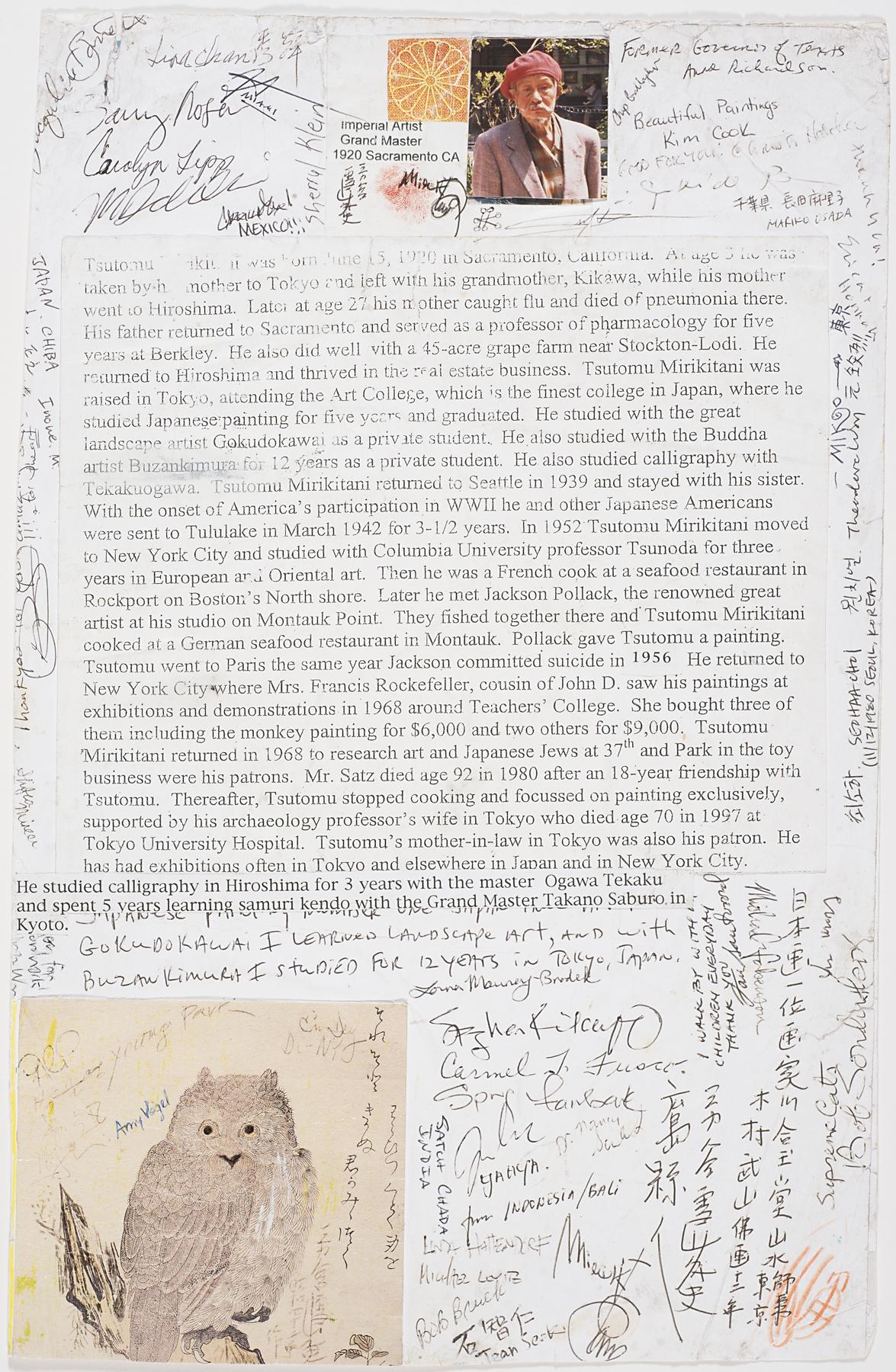
untitled (“education paper") label
These two works are what Mirikitani called his “education papers.” They trace his life from his birth in Sacramento and art training in Tokyo to his incarceration at Tule Lake during World War II and his later career as a New York–based artist. While unhoused from the late 1980s to 2001, Mirikitani carried these papers as his self-made identification—documents he showed to police or curious passersby when asked about his life and art. Containing more components, untitled (“education paper” with owl) is a later, updated version, presumably made from a photocopy of untitled (“education paper” with owl 2).
Beyond serving as biography and self-made ID, the papers also function as collages. The typed narrative, likely prepared by someone who helped organize his story, is layered with Mirikitani’s additions: his photograph, handwritten notes, a photocopy of an owl by the ukiyo-e artist Kitagawa Utamaro, and even the Japanese imperial chrysanthemum seal. Along the margins, signatures and comments from neighbors appear in English, Japanese, Chinese, and Korean—traces of the multiethnic New York community that sustained his art and survival on the streets.
untitled (cat with blue peony)
untitled (cat with fish and peppers), Jimmy Tsutomu Mirikitani

untitled (cat with blue peony) label
While living and working on the streets of New York City, Mirikitani often created art from found materials. This drawing of a smiling black-and-white cat, content amid a bounty of food, was drawn with a ballpoint pen—a medium he favored for its waterproof ink, able to withstand rain and exposure to the elements. Such practical choices were essential to his practice while unhoused. Mirikitani drew on a discarded piece of foam board, visible in the frayed upper edge, embodying his resourceful use of whatever materials were available. Along the top and bottom, small “x” marks reveal where he intended to trim the piece. Like many works made on the streets, this drawing required conservation for exhibition display. Through modest tools and salvaged supports, Mirikitani transformed the discarded materials of daily life into enduring works of art, merging creativity and survival.
Dive Deeper: First Encounter
Artist Roger Shimomura recalls his first meeting with Mirikitani and the impression he left. Video footage from Linda Hattendorf.
Next Section
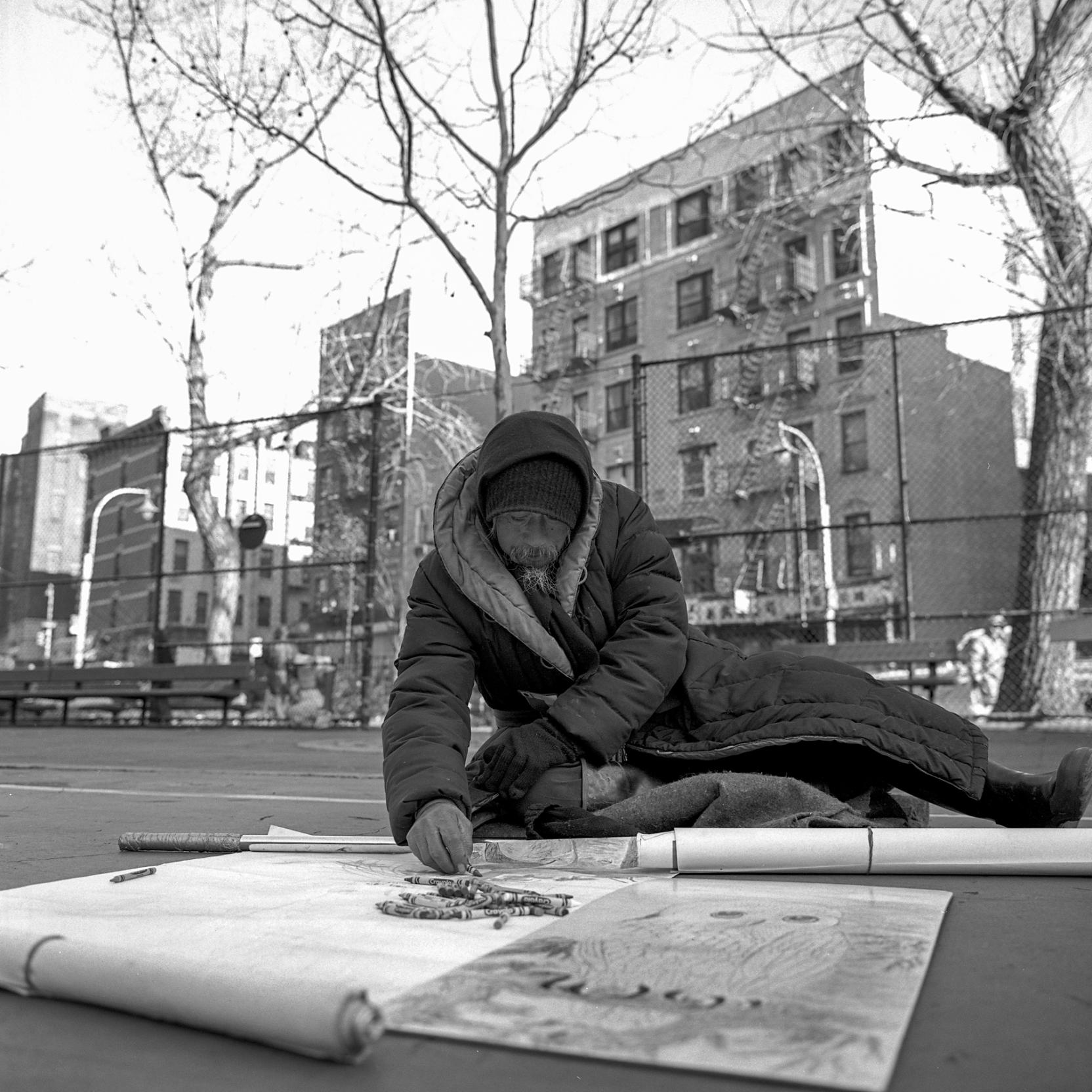
Satō Tesurō, Jimmy Tsutomu Mirikitani on the streets, 1990s, Courtesy of the artist, EL2025.060
Street Nihonga
Mirikitani engaged with and transformed Nihonga, a modern school of painting that emerged in late 19th-century Japan, in response to the materials and encounters of street life. This section illuminates the ways in which he forged a border-crossing form of “street Nihonga”—a fusion of Japanese painting, urban material culture, and the collaborative spirit of Lower Manhattan.