Landscape, Gessen

Artwork Overview

Image not available
Gessen, artist
1741–1809
Landscape, late 1700s, Edo period (1600–1868)
Where object was made: Japan
Material/technique: paper; ink
Dimensions:
Object Height/Width (Height x Width): 101.6 x 27.9 cm
Object Height/Width (Height x Width): 40 x 11 in
Credit line: Museum purchase
Accession number: 1972.0220
Not on display

If you wish to reproduce this image, please submit an image request
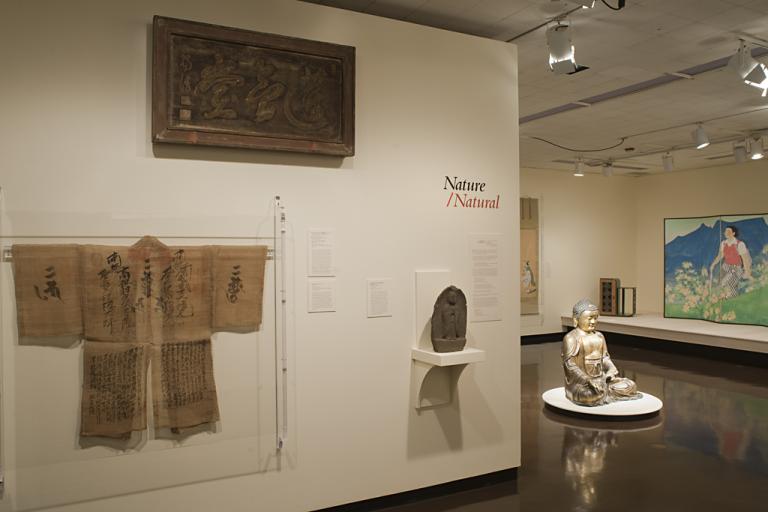
Label texts

Nature/Natural

A versatile painter, Gessen was known for his eccentric behavior. It is documented that whenever he was asked to paint, he accompanied it with his own poem, saying that he preferred his painting NOT be spoiled by vulgar poems of others. In addition, he was notorious for his greed, and thereby nicknamed “beggar Gessen.” However, his reputation drastically changed when later in life, he suddenly donated all of his wealth for the restoration of a Buddhist temple, and for public welfare.

Throughout his life, Gessen eagerly absorbed wide-ranging styles of old and contemporary Japanese masters. First, he studied Sesshu¯ (1420-1506), a master known for unconventional, almost fantastic construction of dynamic three-dimensional space. Later, Gessen was inspired by Yosa Buson (1716-1783), founder of the haiga tradition, which incorporated the aesthetics of Japanese haiku poetry through insightful observations of the everyday world. Both of these two characteristic-dynamism and romanticism-are manifest in the present painting. Unlike a more typical literati preference for reclusion, in this painting Gessen depicts a more contemplative view of a tiny human settlement flanked by severe, vertical mountains.

Nature/Natural

A versatile painter, Gessen was known for his eccentric behavior. It is documented that whenever he was asked to paint, he accompanied it with his own poem, saying that he preferred his painting NOT be spoiled by vulgar poems of others. In addition, he was notorious for his greed, and thereby nicknamed “beggar Gessen.” However, his reputation drastically changed when later in life, he suddenly donated all of his wealth for the restoration of a Buddhist temple, and for public welfare.

Throughout his life, Gessen eagerly absorbed wide-ranging styles of old and contemporary Japanese masters. First, he studied Sesshu¯ (1420-1506), a master known for unconventional, almost fantastic construction of dynamic three-dimensional space. Later, Gessen was inspired by Yosa Buson (1716-1783), founder of the haiga tradition, which incorporated the aesthetics of Japanese haiku poetry through insightful observations of the everyday world. Both of these two characteristic-dynamism and romanticism-are manifest in the present painting. Unlike a more typical literati preference for reclusion, in this painting Gessen depicts a more contemplative view of a tiny human settlement flanked by severe, vertical mountains.

Exhibition Label:
"Nature/Natural," Feb-2011, Kris Ercums
A versatile painter, Gessen was known for his eccentric behavior. It is documented that whenever he was asked to paint, he accompanied it with his own poem, saying that he preferred his painting NOT be spoiled by vulgar poems of others. In addition, he was notorious for his greed, and thereby nicknamed “beggar Gessen.” However, his reputation drastically changed when later in life, he suddenly donated all of his wealth for the restoration of a Buddhist temple, and for public welfare.

Throughout his life, Gessen eagerly absorbed wide-ranging styles of old and contemporary Japanese masters. First, he studied Sesshu¯ (1420-1506), a master known for unconventional, almost fantastic construction of dynamic three-dimensional space. Later, Gessen was inspired by Yosa Buson (1716-1783), founder of the haiga tradition, which incorporated the aesthetics of Japanese haiku poetry through insightful observations of the everyday world. Both of these two characteristic-dynamism and romanticism-are manifest in the present painting. Unlike a more typical literati preference for reclusion, in this painting Gessen depicts a more contemplative view of a tiny human settlement flanked by severe, vertical mountains.

Exhibitions

Kris Ercums, curator
2011–2014
Kris Ercums, curator
2011–2014