black-figure lekythos, Little Lion Class

Artwork Overview
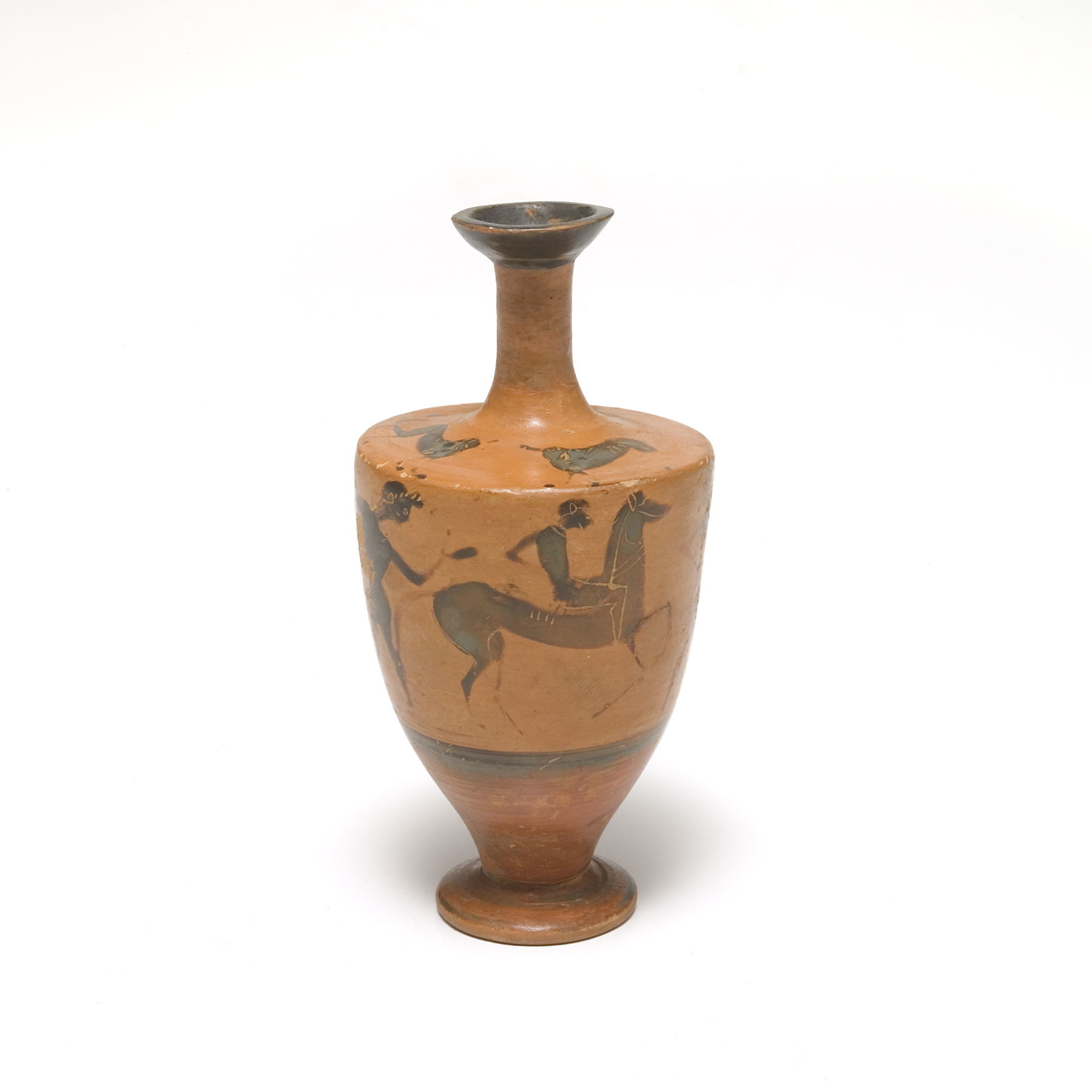
circa 500 BCE–490 BCE
black-figure lekythos, circa 500 BCE
Where object was made: Greece
Material/technique: terracotta; slip
Credit line: Anonymous gift
Accession number: 1988.0032
On display: Brosseau Learning Center

If you wish to reproduce this image, please submit an image request

Images

Label texts

Brosseau Center for Learning: In Conversation with the 2025–26 KU Common Book

Horror vacui (Latin for “fear of empty spaces”) is a common term used in art history used to describe artworks in which the makers fill every possible plane with designs and motifs, with no regard for negative space. This little vase, called a lekythos because of its particular shape with one handle and a narrow opening, was created after the height of horror vacui in Ancient Greece, but still echoes that need to fill all available spaces with decoration. Around the body of the vase, one figure rides a horse while others walk in front and behind the horse. On the shoulder of the vase, two creatures face each other. Later artists filled pages of books with marginalia. Yayoi Kusama manufactures space in order to fill it infinitely.

Today, we humans fill every space physically, mentally, and temporally even more completely than any artists of the past, avoiding even a glimpse of emptiness or a moment to breathe. And yet, there is literally nothing to fear in the openness. Here, let me show you:

Rachel Straughn-Navarro gives the horror one star, and the vacui four and a half stars, if only to leave a little space.

Exhibitions

Scott Barber, curator
Wyatt Haywood, curator
Suzanne Huffman, curator
Ellen Joo, curator
Luke Jordan, curator
Arial Kim, curator
Doug Bergstrom, curator
Susan Earle, curator
Sofía Galarza Liu, curator
Kevin Liu, curator
Kate Meyer, curator
Cara Nordengren, curator
Hana Rose North, curator
Liz Pfeiffer, curator
Sydney Pursel, curator
Rachel Straughn-Navarro, curator
Eli Troen, curator
Maggie Vaughn, curator