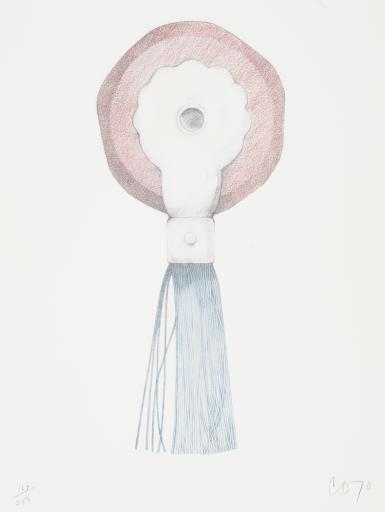
Typewriter Eraser, Paul Bianchini; Claes Oldenburg; Imprimeries Réunies

Artwork Overview
1929–2022
Paul Bianchini, publisher
Typewriter Eraser, 1970
Where object was made: United States
Material/technique: four color offset lithograph; Rives BFK™ paper
Dimensions:
Object Height/Width (Height x Width): 738 x 508 mm
Object Height/Width (Height x Width): 29 1/16 x 20 in
Mat Dimensions (Height x Width): 32 x 24 in
Credit line: Gift of Dr. Mary Jean Nelson
Accession number: 2013.0197
On display: Brosseau Learning Center

If you wish to reproduce this image, please submit an image request

Images

Label texts

Brosseau Center for Learning: In Conversation with the 2025–26 KU Common Book

Pop art is one of the easier art movements to identify and define since the “pop” refers to (pop)ular culture. Artists like Claes Oldenburg and Andy Warhol drew inspiration from common aspects of modern life such as mass-produced items, comics, and advertisements. But what happens when pop stops being popular?

Oldenburg is best known for his large recreations and interpretations of everyday objects, and he repeatedly visited this disk-like red shape with a brush attachment, better known by some as a typewriter eraser. Before Microsoft Word or Google Docs, if you wanted to type something you used a manual typewriter. And if you made a mistake, there was no backspace key to delete it. A typewriter eraser could erase typewriter ink and was conveniently shaped to erase a line of type and then sweep the eraser crumbs away. What a marvel!

Much like the worn edges of a well-used typewriter eraser, the way in which we lose aspects of our collective identity, practices, and traditions, is called cultural erosion. Students do not know what typewriter erasers do. They have never seen one before. At the Spencer, we have to keep an actual eraser handy to make clear what once was commonplace. Part of the pop is now absent from this Pop art.

Is it so bad if I didn’t recognize this typewriter eraser as such the first time I saw it? Oldenburg makes it visually compelling, even monumental, and its mysteriousness captured my attention. It still pops, but the pop comes from the eye-catching style rather than familiar content.

It would be odd for typewriter erasers to stay commonplace. We still make plenty of mistakes, but at least when typing via word processors there are easier ways to erase them. Oldenburg will continue to be remembered, even if the products he depicted become obsolete. As our cultures erode, we forget things we shouldn’t forget. Our cultures also retain practices and behaviors we needn’t perpetuate. Cultural erosion is inevitable, sometimes fortunate and sometimes tragic.

Kate Meyer gives cultural erosion three stars.

Exhibitions

Scott Barber, curator
Wyatt Haywood, curator
Suzanne Huffman, curator
Ellen Joo, curator
Luke Jordan, curator
Arial Kim, curator
Doug Bergstrom, curator
Susan Earle, curator
Sofía Galarza Liu, curator
Kevin Liu, curator
Kate Meyer, curator
Cara Nordengren, curator
Hana Rose North, curator
Liz Pfeiffer, curator
Sydney Pursel, curator
Rachel Straughn-Navarro, curator
Eli Troen, curator
Maggie Vaughn, curator