Chaekgeori (Scholar’s Accoutrements) with munjado, Hwang Seung-gyu

Artwork Overview

Image not available
1886–1962
Chaekgeori (Scholar’s Accoutrements) with munjado, early 1900s
Where object was made: Korea
Material/technique: paper; color; ink
Dimensions:
Object Height/Width (Height x Width): 138 x 264 cm
Object Height/Width (Height x Width): 54 5/16 x 103 15/16 in
Credit line: Private collection
Accession number: EL2017.005
Not on display

If you wish to reproduce this image, please submit an image request
Label texts

The Power and Pleasure of Possessions in Korean Painted Screens

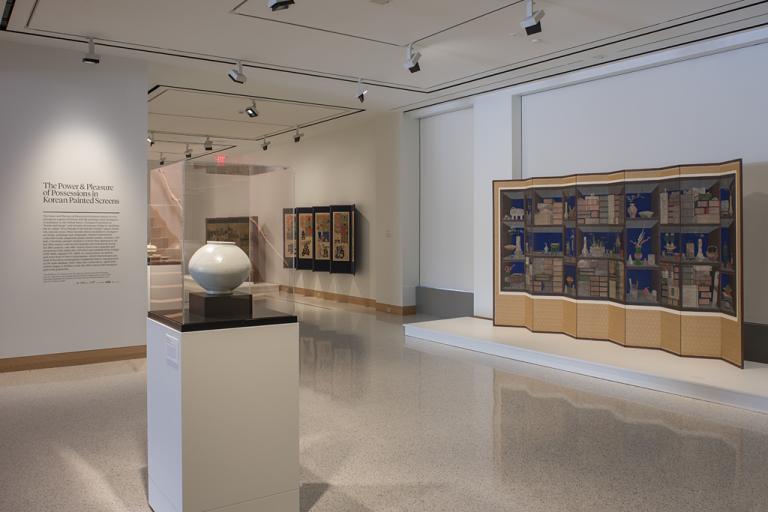
This work combines chaekgeori with munjado (문자도/文字圖) or “calligraphic pictures.” In the painting, books and furniture are flattened into abstract, wallpaper-like patterns, while flowers and birds freely weave in and out of the boundaries defined by the books. Underneath, bold Korean characters are painted in striking black. Reading from right to left, the characters are the eight Confucian virtues: filial piety, fraternal devotion, loyalty, trust, courtesy, commitment, integrity, and humility (효제충신예의염치/ 孝悌忠信禮義廉恥). This type of folk-style painting was popular in the rural area of Gangwon Province, South Korea. Judging by the style, the artist is believed to be Hwang Seung-gyu, who worked in Gangwon Province during the Japanese occupation of Korea (1910–1945).

The Power and Pleasure of Possessions in Korean Painted Screens

This work combines chaekgeori with munjado (문자도/文字圖)
or “calligraphic pictures.” In the painting, books and furniture
are flattened into abstract, wallpaper-like patterns, while flowers
and birds freely weave in and out of the boundaries defined by
the books. Underneath, bold Korean characters are painted in
striking black. Reading from right to left, the characters are the
eight Confucian virtues: filial piety, fraternal devotion, loyalty, trust,
courtesy, commitment, integrity, and humility (효제충신예의염치/
孝悌忠信禮義廉恥). This type of folk-style painting was popular in
the rural area of Gangwon Province, South Korea. Judging by the
style, the artist is believed to be Hwang Seung-gyu, who worked
in Gangwon Province during the Japanese occupation of Korea
(1910–1945).

Exhibitions