Chaekgeori (Scholar’s Accoutrements), unknown maker from Korea

Artwork Overview

Image not available
Chaekgeori (Scholar’s Accoutrements) , late 1800s, Joseon dynasty (1392–1910)
Where object was made: Korea
Material/technique: paper; ink
Dimensions:
Object Height/Width (Height x Width): 125 x 392 cm
Object Height/Width (Height x Width): 49 3/16 x 154 5/16 in
Credit line: Private collection
Accession number: EL2017.010
Not on display

If you wish to reproduce this image, please submit an image request
Label texts

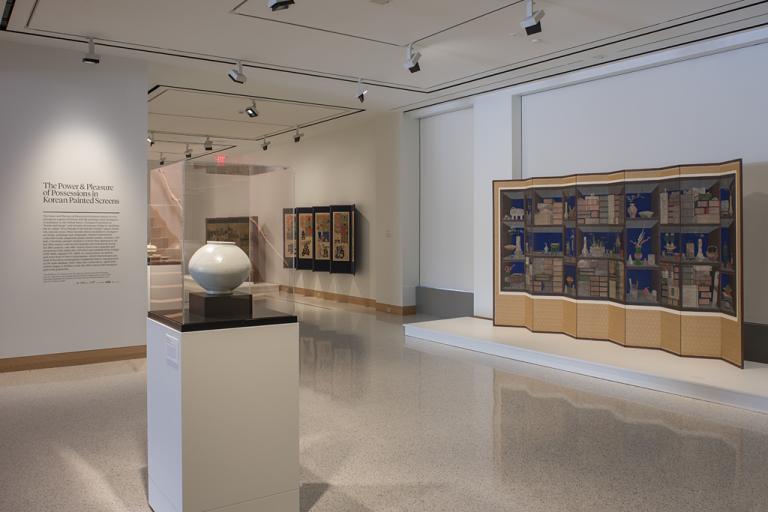
The Power and Pleasure of Possessions in Korean Painted Screens

Unlike most chaekgeori, this screen was painted using only black ink. Not only is the monochromatic composition rare, but the incorporation of talismanic Buddhist patterns in the background is also unusual. The furniture, piles of books, and paper holders are clustered together in one large mass within each panel—as in other folk-style chaekgeori—but here the clustered pattern is not limited to the items. Even the talismanic patterns are placed together in close proximity. By combining numerous and varied auspicious subjects, this painting indicates the desire for both scholarly achievement and prosperity. Lacking brilliant colors, this screen oscillates between the modest taste of the Confucian gentleman and a human desire for protection and prosperity.

The Power and Pleasure of Possessions in Korean Painted Screens

Unlike most chaekgeori, this screen was painted using only black
ink. Not only is the monochromatic composition rare, but the
incorporation of talismanic Buddhist patterns in the background is
also unusual. The furniture, piles of books, and paper holders are
clustered together in one large mass within each panel—as in other
folk-style chaekgeori—but here the clustered pattern is not limited
to the items. Even the talismanic patterns are placed together in
close proximity. By combining numerous and varied auspicious
subjects, this painting indicates the desire for both scholarly
achievement and prosperity. Lacking brilliant colors, this screen
oscillates between the modest taste of the Confucian gentleman
and a human desire for protection and prosperity.

Exhibitions