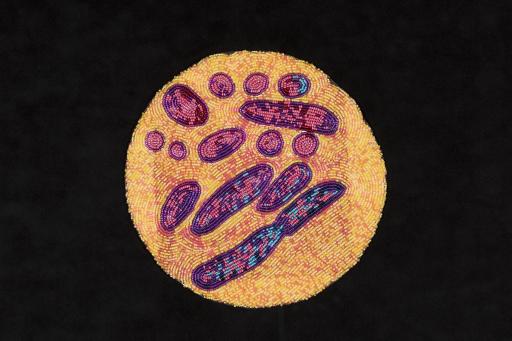
Reserving: Tuberculosis, Ruth Cuthand

Artwork Overview

Ruth Cuthand, artist
Cultural affiliations: Plains Cree
born 1953
Reserving: Tuberculosis, 2018
Where object was made: Canada
Material/technique: acrylic; glass beads; thread; velvet backing
Credit line: Museum purchase: Helen Foresman Spencer Art Acquisition Fund
Accession number: 2019.0143
On display: Brosseau Learning Center

If you wish to reproduce this image, please submit an image request

Images

Label texts

Brosseau Center for Learning: In Conversation with the 2025–26 KU Common Book

Tuberculosis, aka TB, White Death, White Man’s Plague, Consumption, and more have been used to describe the disease that still causes the most deaths, killing approximately 1.3 million people worldwide annually. Since 1946 we have had a treatment and cure, but access to the medications is costly and not available everywhere.

Speaking of everywhere, you know that phenomenon where you start noticing something you recently learned about? It’s called the Baader-Meinhof Phenomenon or frequency illusion and when I started researching tuberculosis, this happened to me. I watched Moulin Rouge! where Satine dies of consumption. I went to a screening of Nanook of the North and learned he died of tuberculosis. Then my partner tells me TB has a role in an old videogame he used to play, Red Dead Redemption 2. And how did I not know that Fantine from Les Misérables had consumption before now? Through my research I learned about many artists that had connections to tuberculosis including Edgar Allen Poe, Edvard Munch, John Keats, Chopin, Rembrandt, and the Brontë sisters. And that consumption was fashionable in the Victorian Era, setting beauty standards that we still adhere to today. TB even changed skirt lengths!

When it comes to Natives and disease, smallpox typically gets all the rap, but diseases like tuberculosis quickly spread amongst Indigenous populations, particularly on reservations where they lived in close quarters and experienced co-morbidities like malnutrition and compromised immune systems.

Maybe it isn’t just the cognitive bias but tuberculosis really is everywhere, after all, John Green’s newest book is Everything is Tuberculosis: The History and Persistence of Our Deadliest Infection. At the height of the disease in the 1800s, nearly 25% of all deaths in Europe were caused by TB, so it is not that surprising that so many people were affected nor that it is so prevalent in popular culture, books, film, art, and historical accounts.

Sydney Pursel gives tuberculosis one star.

Healing, Knowing, Seeing the Body

Through vibrant, intricate beadwork, First Nations artist Ruth Cuthand explores the historical connections among colonialism, race, and disease by depicting microscopic views of pathogens like tuberculosis (shown here), whooping cough, measles, HIV, and, most recently, Covid-19. Historically, infectious diseases disproportionately affected Indigenous communities, and similar health disparities continue today as a result of deep-seated inequity and ongoing systemic violence against Black and Indigenous populations and other people of color. Cuthand’s chosen medium further reflects this complex history. Like many infectious diseases, glass beads were first introduced in the Western Hemisphere by European colonizers who traded the inexpensive items for valuable furs and other goods; like infectious diseases, they fundamentally disrupted Indigenous ways of life.

Healing, Knowing, Seeing the Body

Through vibrant, intricate beadwork, First Nations artist Ruth Cuthand explores the historical connections among colonialism, race, and disease by depicting microscopic views of pathogens like tuberculosis (shown here), whooping cough, measles, HIV, and, most recently, Covid-19. Historically, infectious diseases disproportionately affected Indigenous communities, and similar health disparities continue today as a result of deep-seated inequity and ongoing systemic violence against Black and Indigenous populations and other people of color. Cuthand’s chosen medium further reflects this complex history. Like many infectious diseases, glass beads were first introduced in the Western Hemisphere by European colonizers who traded the inexpensive items for valuable furs and other goods; like infectious diseases, they fundamentally disrupted Indigenous ways of life.

Exhibitions

Cassandra Mesick Braun, curator
2021
Cassandra Mesick Braun, curator
2021
Scott Barber, curator
Wyatt Haywood, curator
Suzanne Huffman, curator
Ellen Joo, curator
Luke Jordan, curator
Arial Kim, curator
Doug Bergstrom, curator
Susan Earle, curator
Sofía Galarza Liu, curator
Kevin Liu, curator
Kate Meyer, curator
Cara Nordengren, curator
Hana Rose North, curator
Liz Pfeiffer, curator
Sydney Pursel, curator
Rachel Straughn-Navarro, curator
Eli Troen, curator
Maggie Vaughn, curator

Resources

Links