St. Vincent Ferrer, unknown maker from Spain; unknown maker from Colombia

Artwork Overview

Image not available
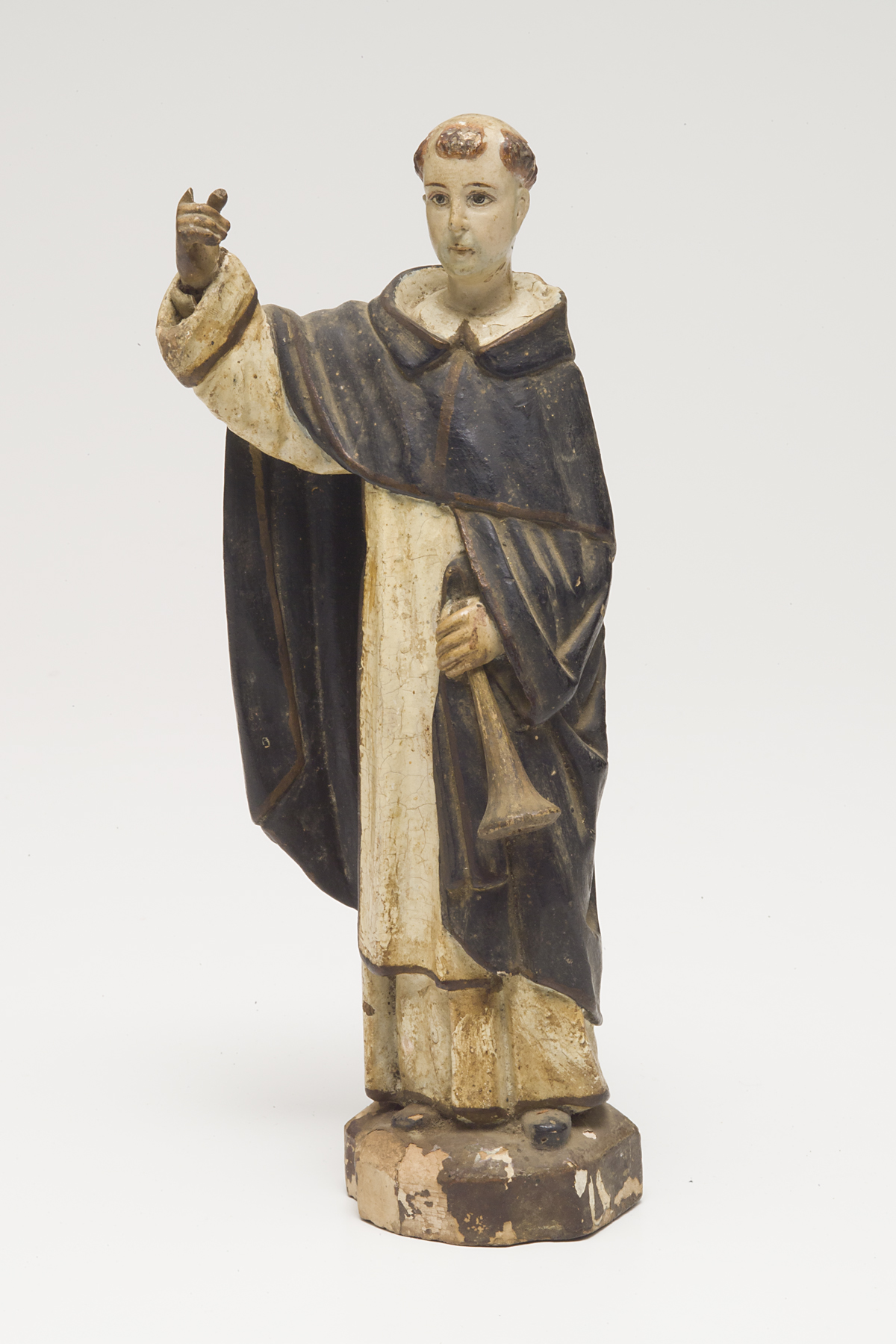
St. Vincent Ferrer , 1700s
Where object was made: Spain
Material/technique: wood; polychromy; carving
Dimensions:
Object Height/Width/Depth (Height x Width x Depth): a: figure 30 x 10.8 x 9.7 cm
Object Height/Width/Depth (Height x Width x Depth): 11 13/16 x 4 1/4 x 3 13/16 in
Object Height/Diameter (Height x Diameter): b: trumpet 5.8 x 2.3 cm
Object Height/Diameter (Height x Diameter): 2 5/16 x 0 7/8 in
Credit line: Gift of Mrs. Pierre A.D. Stouse Jr.
Accession number: 1978.0066.a,b
On display: Loo Gallery

If you wish to reproduce this image, please submit an image request
Images

Label texts

Debut

Although Spanish conquistadors passed through what is now New Mexico as early as 1527 searching for gold and silver, the first permanent Spanish settlements in the area were not established until 1598. As part of these settlements, Catholic priests arrived to establish churches and convert Indigenous populations to Catholicism. In addition to bringing religious traditions from Europe, these early missionaries also introduced the art of carving various saints and angels from wood or ivory. Local artisans quickly adapted this artform to incorporate their own traditions and religious practices. These carved figures of saints represent two examples of this living tradition.

Debut

Although Spanish conquistadors passed through what is now New Mexico as early as 1527 searching for gold and silver, the first permanent Spanish settlements in the area were not established until 1598. As part of these settlements, Catholic priests arrived to establish churches and convert Indigenous populations to Catholicism. In addition to bringing religious traditions from Europe, these early missionaries also introduced the art of carving various saints and angels from wood or ivory. Local artisans quickly adapted this artform to incorporate their own traditions and religious practices. These carved figures of saints represent two examples of this living tradition.

Exhibitions

Kris Ercums, curator
2021–2023
Kris Ercums, curator
2021–2022