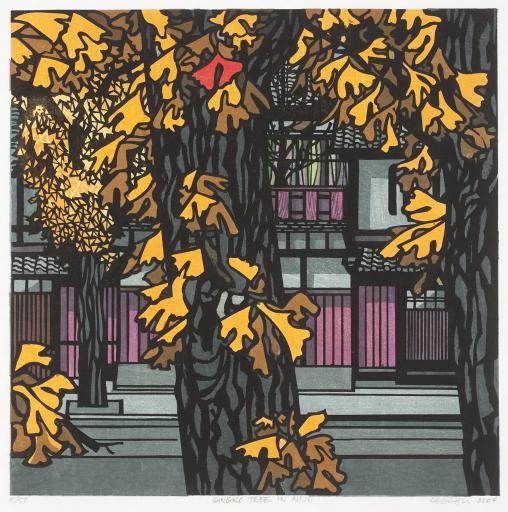
Gingko Trees in Nijo, Clifton Karhu

Artwork Overview
1927–2007
Gingko Trees in Nijo, 2004
Where object was made: Japan
Material/technique: color woodcut
Dimensions:
Image Dimensions Height/Width (Height x Width): 397 x 400 mm
Image Dimensions Height/Width (Height x Width): 15 5/8 x 15 3/4 in
Sheet/Paper Dimensions (Height x Width): 370 x 448 mm
Sheet/Paper Dimensions (Height x Width): 14 9/16 x 17 5/8 in
Mat Dimensions (Height x Width): 25 x 20 in
Credit line: Gift of Ted and Sumie Childers
Accession number: 2011.0082
On display: Brosseau Learning Center

If you wish to reproduce this image, please submit an image request

Images

Label texts

Brosseau Center for Learning: In Conversation with the 2025–26 KU Common Book

How did you get here? This question gets asked every time I walk the dogs by the ginkgo tree. Sometimes it's hard to tell who the question is being asked to. Is it the tree or is it myself? This ginkgo tree with its leaves scaling the surface of the branches that snake around looking for a meal of sunshine. Stone still, I will stare at this Medusa. Who appears like an ordinary tree but is significantly different. Two hundred and ninety million years ago in the Permian epic, the first ginkgo appeared along with the evergreens and the fern trees, of which it is related. Twice as old as the deciduous trees we are familiar with today. It survived five mass extinction events, including the Great Dying, where 90% of all living things disappeared. Today, it is the sole survivor of its species. All but its most distant cousins have perished. Yet from where it clung on in a small area in central China, this ginkgo has made a home here in Kansas. Among all these flowering trees. The last of its kind. High Summer snaking green branches capturing me, or its amber vomit-smelling seed cases of late Summer, or its Fall golden yellow leaves. There is a print by Clifton Karhu of these golden yellow leaves in Kyoto Japan.

Minnesota is populated by large numbers of Scandinavians. Born of Finnish immigrants in northern Minnesota where Clifton Karhu spent his formative years. He spent his time during WWII in Japan. Returning home to Minnesota after his service. He went back to Japan after the occupation as a Lutheran Missionary. Over time, he adapted to and then adopted Japanese culture. They adopted him. I am sure many Westerners traveling in Japan as well as many of the Japanese maybe even Clifton himself asked that question: “How did you get here?”

This ginkgo has travelled far and over great lengths of time to arrive here in my neighborhood periodically becoming a mystical beast of wonder for my dogs and me. I feel I can do little more than appreciate all its marvelous history and beauty.

Doug Bergstrom gives ginkgo trees five stars.

Exhibitions

Scott Barber, curator
Wyatt Haywood, curator
Suzanne Huffman, curator
Ellen Joo, curator
Luke Jordan, curator
Arial Kim, curator
Doug Bergstrom, curator
Susan Earle, curator
Sofía Galarza Liu, curator
Kevin Liu, curator
Kate Meyer, curator
Cara Nordengren, curator
Hana Rose North, curator
Liz Pfeiffer, curator
Sydney Pursel, curator
Rachel Straughn-Navarro, curator
Eli Troen, curator
Maggie Vaughn, curator