egg cup, unknown maker from the United States

Artwork Overview
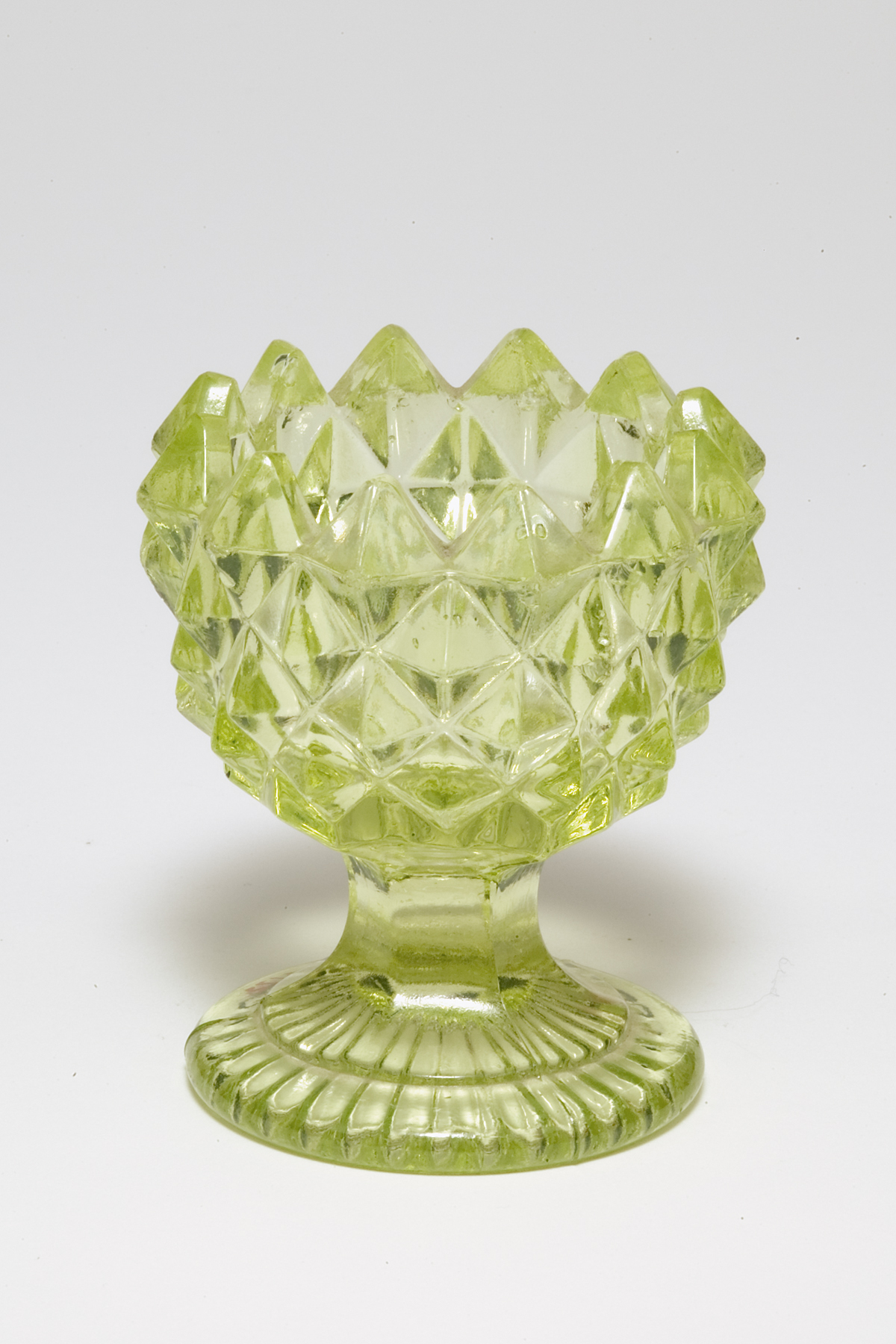
egg cup
early-mid 1800s
egg cup , early-mid 1800s
Where object was made: United States
Material/technique: pressed uranium glass
Dimensions:
Object Height/Diameter (Height x Diameter): 8.3 x 7.3 cm
Object Height/Diameter (Height x Diameter): 3 1/4 x 2 7/8 in
Credit line: William Bridges Thayer Memorial
Accession number: 1928.6172
On display: Brosseau Learning Center

If you wish to reproduce this image, please submit an image request

Images

Label texts

Brosseau Center for Learning: In Conversation with the 2025–26 KU Common Book

In the 1830s uranium oxide was first used in Bohemia to give glass a distinctive yellow green color. Uranium glass (also known as Vaseline glass or Canary glass) reached its height in popularity in the late 1800s and was commercially produced in Europe and the United States.

Uranium is naturally occurring and in 1896 Henri Becquerel discovered that it was radioactive when he concluded it gave off invisible rays of energy that penetrated solid objects. His student, Marie Curie, named this phenomena radioactivity. Radioactive materials are made of atoms containing unstable nuclei. These atoms give off energy as radiation that is invisible to humans and unlike other forms of energy, such as heat, cannot be felt by humans. It is human nature to fear what we cannot see and radiation is no exception.

In the years after radiation was discovered its potential dangers were not well understood which led to illness and death among some of the people who worked with radioactive materials. This is one of many reasons that people may be wary of radiation to this day.

Humans have harnessed different types of radiation for a wide range of uses, from medical x-ray imaging to weapons including nuclear bombs. I find radiation is fascinating in that it has the power to save lives as well as to kill.

We now understand that some types of radiation are known human carcinogens and precautions are taken when we use even low doses of radiation for routine medical procedures, for example dental x-rays and mammography.

I think there is a certain amount of irony in the fact that targeted radiation is an effective treatment for some cancers. My first intense medical experience with radiation was swallowing a capsule of radioactive iodine which used the thyroid’s natural iodine uptake to destroy cancerous thyroid cells. Years later, I benefited again from very targeted radiation treatments to treat a very early-stage breast cancer that was diagnosed by you guessed it, a routine mammogram.

Sofía Galarza Liu gives radiation four stars.

Exhibitions

Scott Barber, curator
Wyatt Haywood, curator
Suzanne Huffman, curator
Ellen Joo, curator
Luke Jordan, curator
Arial Kim, curator
Doug Bergstrom, curator
Susan Earle, curator
Sofía Galarza Liu, curator
Kevin Liu, curator
Kate Meyer, curator
Cara Nordengren, curator
Hana Rose North, curator
Liz Pfeiffer, curator
Sydney Pursel, curator
Rachel Straughn-Navarro, curator
Eli Troen, curator
Maggie Vaughn, curator